Check out the following:

Tuesday, March 09, 2010


Saturday, March 06, 2010
'They Need to Be Liberated From Their God'
Check out this fascinating interview with Mosab Hassan Yousef, the son of Hamas founder Sheikh Hassan Yousef. He talks about his conversion to Christianity and his work for Israeli intelligence while a member of Hamas. He reports that he worked with Israeli intelligence to save lives on both sides. Listen to him speak about his conversion.
أَبَانَا الَّذِي فِي السَّمَاوَاتِ لِيَتَقَدَّسِ اسْمُكَ. لِيَأْتِ مَلَكُوتُكَ. لِتَكُنْ مَشِيئَتُكَ كَمَا فِي السَّمَاءِ كَذَلِكَ عَلَى الأَرْضِ
"I converted to Christianity because I was convinced by Jesus Christ as a character, as a personality. I loved him, his wisdom, his love, his unconditional love. I didn't leave [the Islamic] religion to put myself in another box of religion. At the same time it's a beautiful thing to see my God exist in my life and see the change in my life. I see that when he does exist in other Middle Easterners there will be a change."He also reports that the fundamental difficulty with Islam is that the God of Islam is not the right God.
"What matters is not whether my father is a fanatic or not, he's doing the will of a fanatic God. It doesn't matter if he's a terrorist or a traditional Muslim. At the end of the day a traditional Muslim is doing the will of a fanatic, fundamentalist, terrorist God. I know this is harsh to say. Most governments avoid this subject. They don't want to admit this is an ideological war. ..... The problem is not in Muslims...the problem is with their God. They need to be liberated from their God. He is their biggest enemy. It has been 1,400 years they have been lied to."May God raise up millions of Middle Easterners who really know God and show it! May they teach us in the West what it looks like when you really know God! May Christ reign over the Middle East in a way that shows the world who he really is - not some by-product of the West or corrupted icon of marauding Crusaders but something much better, purer, altogether different and glorious!
أَبَانَا الَّذِي فِي السَّمَاوَاتِ لِيَتَقَدَّسِ اسْمُكَ. لِيَأْتِ مَلَكُوتُكَ. لِتَكُنْ مَشِيئَتُكَ كَمَا فِي السَّمَاءِ كَذَلِكَ عَلَى الأَرْضِ
Friday, February 26, 2010

Seen Any Martyrs Recently?
This is disturbing.
Pray for these Christians, contribute to the Voice of the Martyrs or Open Doors and contact Congress.
Pray for these Christians, contribute to the Voice of the Martyrs or Open Doors and contact Congress.
Wednesday, February 24, 2010
Do You Remember Getting Your "Bell Rung" in HS Football?
I remember getting "your bell rung" was a normal part of playing football. One time I popped my Riddell air-filled helmet. Another time I bent my facemask on another guys head during a kickoff. We called the kickoff team the "suicide squad" - for good reason. After I bent my facemask everything turned yellow and this load hum filled my ears - probably a concussion.
I am glad for the heightened awareness of concussions these days. The NFL and our local high schools as well are actively seeking to protect athletes from concussions. Hopefully, getting "your bell rung" will be a thing of the past for all athletes.
Check out these articles here:
Dangerous games: As dozens suffer concussions, awareness of risks grows .
N.F.L. Acknowledges Long-Term Concussion Effects
I am glad for the heightened awareness of concussions these days. The NFL and our local high schools as well are actively seeking to protect athletes from concussions. Hopefully, getting "your bell rung" will be a thing of the past for all athletes.
Check out these articles here:
Dangerous games: As dozens suffer concussions, awareness of risks grows .
N.F.L. Acknowledges Long-Term Concussion Effects
Can My Marriage Change if My Spouse Doesn't Change?
Some wisdom for improving your marriage from Winston Smith:
"Why do you see the speck that is in your brother's eye, but do not notice the log that is in your own eye? Or how can you say to your brother, ‘Let me take the speck out of your eye,’ when there is the log in your own eye? You hypocrite, first take the log out of your own eye, and then you will see clearly to take the speck out of your brother's eye."
Tuesday, February 23, 2010
Together for the Gospel
I am so looking forward to being at T4G with our guys, Jeff, Phil and David and many other friends.
And I'm looking forward to hearing from a man who greatly influenced my life - RC Sproul - a great husband and dad, bible teacher, theologian, football fan, golfer, ballroom dancer, outdoorsman and a funny guy.
Check out this video:
And this:
And I'm looking forward to hearing from a man who greatly influenced my life - RC Sproul - a great husband and dad, bible teacher, theologian, football fan, golfer, ballroom dancer, outdoorsman and a funny guy.
Check out this video:
R.C. Sproul - Study Video from Together for the Gospel (T4G) on Vimeo.
And this:
Together for the Gospel: T4G 2010 Conference from Together for the Gospel (T4G) on Vimeo.
Saturday, February 20, 2010
Sermon on the Mount from Memory
We are in a series on the Sermon on the Mount entitled, "Kingdom Living". Studying the Sermon on the Mount has been rich and rewarding. Check out this recitation of the Sermon on the Mount from memory given by Pastor Trevin Wax.
HT: Bruce Webb
Part 1:
Part 2:
HT: Bruce Webb
Part 1:
Part 2:
Love in Marriage - A Follow-up to the Five Love Languages
In case anyone who read David Powlison's gracious critique of "Five Love Languages" might think him an armchair quarterback, please look at some of his excellent counsel for married couples. I know few people who combine the biblical wisdom and gracious care that David displays while wisely discerning the good, bad and neutral of the broader counseling world. Check out the following and see what you think.
- On Marital Intimacy, Part 1
- On Marital Intimacy, Part 2
- On Marital Intimacy, Part 3
- Making All Things New: Restoring Pure Joy to the Sexually Broken
- More Resources at Christian Counseling and Education Foundation
Thursday, February 18, 2010
The Five Love Languages
Justin Taylor has an excellent post reviewing the very popular book, "The Five Love Languages" by Gary Chapman.
Here are some highlights:
While this book has some excellent insight into how people communicate love, it can be understood and practiced in a way very contrary to the Kingdom ethic of love we find in the Sermon on the Mount. King of Grace church is going through a series on the Sermon on the Mount entitled, "Kingdom Living". Listen to the message on Kingdom love, "Be Perfect", here.
Here are some highlights:
Chapman’s model, Powlison argues, fails the class “Human Nature 101.”Please take 5 minutes to read the whole thing here.
Like all secular interpretations of human psychology (even when lightly Christianized), it makes some good observations and offers some half-decent advice (of the sort that self-effort can sometimes follow). But it doesn’t really understand human psychology. That basic misunderstanding has systematic distorting and misleading effects. Fallenness not only brings ignorance about how best to love others; it brings a perverse unwillingness and inability to love. It ingrains the perception that our lusts are in fact needs, empty places inside where others have disappointed us. The empty emotional tank construct is congenial to our fallen instincts, not transformative. It leaves what we instinctively want as an unquestionable good that must somehow be fulfilled. It not only leaves fundamental self-interest unchallenged, it plays to self-interest. . . .Powlison goes on to contrast this perspective with the foreign “love language” of Christ:
The love of Christ speaks a “love language”—mercy to hellishly self-centered people—that no person can hear or understand unless God gives ears to hear. It is a language we cannot speak to others unless God makes us fluent in an essentially foreign language. We might say that the itch itself (an ear for God’s language) has to be created, because we live in such a stupor of self-centered itchiness. The love language model does not highlight those exquisite forms of love that do not “speak your language.” You and I need to learn a new language if we are to become fit to live with each other and with God. The greatest love ever shown does not speak the instinctively self-centered language of the recipients of such love. In fundamental ways, the love of Christ speaks contrary to your “love language” and “felt needs.” Does anyone naturally say, “I need You to rule me so I’m no longer ruled by what I want”? Does anyone naturally say, “For Your name’s sake, O LORD, pardon my iniquity for it is great” (Psalm 25:11)? Does anyone naturally say, “My greatest need is for mercy, and then for the wisdom to give mercy. I long for redemption. May Your kingdom come. Deliver us from evil”?
God’s grace aims to destroy the lordship of the five love languages, even while teaching us to speak the countless love languages with greater fluency.
While this book has some excellent insight into how people communicate love, it can be understood and practiced in a way very contrary to the Kingdom ethic of love we find in the Sermon on the Mount. King of Grace church is going through a series on the Sermon on the Mount entitled, "Kingdom Living". Listen to the message on Kingdom love, "Be Perfect", here.
Friday, February 05, 2010
The Weight of Glory
It's been almost two months since my last blog - sorry! I guess it has been a very full two months. Lots of good things going on - full family life, helping my High-School age kids with homework, lots of wonderful pastoring stuff, Alpha, learning Hebrew, teaching Latin, and, I'm sure, some degree of just goofing off.
Anyhow - in preparation for preaching from Mt. 6:1-4 in our Sermon on the Mount series I was reading some CS Lewis. I think he had it right in many ways in his understanding of heavenly reward. ( BTW - I very much like Lewis but do not consider him entirely reliabletheologically.) Take about 15 minutes or so and read his excellent essay, "The Weight of Glory", available through the Doxa website.
Enjoy!
The essay is reproduced below from the Doxa site.
Preached originally as a sermon in the Church of St Mary the Virgin, Oxford, on June 8, 1942: published in THEOLOGY, November, 1941, and by the S.P.C.K, 1942
If you asked twenty good men to-day what they thought the highest of the virtues, nineteen of them would reply, Unselfishness. But if you asked almost any of the great Christians of old he would have replied, Love. You see what has happened? A negative term has been substituted for a positive, and this is of more than philological importance. The negative ideal of Unselfishness carries with it the suggestion not primarily of securing good things for others, but of going without them ourselves, as if our abstinence and not their happiness was the important point. I do not think this is the Christian virtue of Love. The New Testament has lots to say about self-denial, but not about self-denial as an end in itself. We are told to deny ourselves and to take up our crosses in order that we may follow Christ; and nearly every description of what we shall ultimately find if we do so contains an appeal to desire. If there lurks in most modern minds the notion that to desire our own good and earnestly to hope for the enjoyment of it is a bad thing, I submit that this notion has crept in from Kant and the Stoics and is no part of the Christian faith. Indeed, if we consider the unblushing promises of reward and the staggering nature of the rewards promised in the Gospels, it would seem that Our Lord finds our desires, not too strong, but too weak. We are half-hearted creatures, fooling about with drink and sex and ambition when infinite joy is offered us, like an ignorant child who wants to go on making mud pies in a slum because he cannot imagine what is meant by the offer of a holiday at the sea. We are far too easily pleased.
We must not be troubled by unbelievers when they say that this promise of reward makes the Christian life a mercenary affair. There are different kinds of reward. There is the reward which has no natural connexion with the things you do to earn it, and is quite foreign to the desires that ought to accompany those things. Money is not the natural reward of love; that is why we call a man mercenary if he marries a woman for the sake of her money. But marriage is the proper reward for a real lover, and he is not mercenary for desiring it. A general who fights well in order to get a peerage is mercenary; a general who fights for victory is not, victory being the proper reward of battle as marriage is the proper reward of love. The proper rewards are not simply tacked on to the activity for which they are given, but are the activity itself in consummation. There is also a third case, which is more complicated. An enjoyment of Greek poetry is certainly a proper, and not a mercenary, reward for learning Greek; but only those who have reached the stage of enjoying Greek poetry can tell from their own experience that this is so. The schoolboy beginning Greek grammar cannot look forward to his adult enjoyment of Sophocles as a lover looks forward to marriage or a general to victory. He has to begin by working for marks, or to escape punishment, or to please his parents, or, at best, in the hope of a future good which he cannot at present imagine or desire. His position, therefore, bears a certain resemblance to that of the mercenary; the reward he is going to get will, in actual fact, be a natural or proper reward, but he will not know that till he has got it. Of course, he gets it gradually; enjoyment creeps in upon the mere drudgery, and nobody could point to a day or an hour when the one ceased and the other began. But it is just in so far as he approaches the reward that be becomes able to desire it for its own sake; indeed, the power of so desiring it is itself a preliminary reward
The Christian, in relation to heaven, is in much the same position as this schoolboy. Those who have attained everlasting life in the vision of God doubtless know very well that it is no mere bribe, but the very consummation of their earthly discipleship; but we who have not yet attained it cannot know this in the same way, and cannot even begin to know it at all except by continuing to obey and finding the first reward of our obedience in our increasing power to desire the ultimate reward. Just in proportion as the desire grows, our fear lest it should be a mercenary desire will die away and finally be recognized as an absurdity. But probably this will not, for most of us, happen in a day; poetry replaces grammar, gospel replaces law, longing transforms obedience, as gradually as the tide lifts a grounded ship.
But there is one other important similarity between the schoolboy and ourselves. If he is an imaginative boy he will, quite probably, be revelling in the English poets and romancers suitable to his age some time before he begins to suspect that Greek grammar is going to lead him to more and more enjoyments of this same sort. He may even be neglecting his Greek to read Shelley and Swinburne in secret. In other words, the desire which Greek is really going to gratify already exists in him and is attached to objects which seem to him quite unconnected with Xenophon and the verbs in ??. Now, if we are made for heaven, the desire for our proper place will be already in us, but not yet attached to the true object, and will even appear as the rival of that object. And this, I think, is just what we find. No doubt there is one point in which my analogy of the schoolboy breaks down. The English poetry which he reads when he ought to be doing Greek exercises may be just as good as the Greek poetry to which the exercises are leading him, so that in fixing on Milton instead of journeying on to Aeschylus his desire is not embracing a false object. But our case is very different. If a transtemporal, transfinite good is our real destiny, then any other good on which our desire fixes must be in some degree fallacious, must bear at best only a symbolical relation to what will truly satisfy.
In speaking of this desire for our own far- off country, which we find in ourselves even now, I feel a certain shyness. I am almost committing an indecency. I am trying to rip open the inconsolable secret in each one of you—the secret which hurts so much that you take your revenge on it by calling it names like Nostalgia and Romanticism and Adolescence; the secret also which pierces with such sweetness that when, in very intimate conversation, the mention of it becomes imminent, we grow awkward and affect to laugh at ourselves; the secret we cannot hide and cannot tell, though we desire to do both. We cannot tell it because it is a desire for something that has never actually appeared in our experience. We cannot hide it because our experience is constantly suggesting it, and we betray ourselves like lovers at the mention of a name. Our commonest expedient is to call it beauty and behave as if that had settled the matter. Wordsworth’s expedient was to identify it with certain moments in his own past. But all this is a cheat. If Wordsworth had gone back to those moments in the past, he would not have found the thing itself, but only the reminder of it; what he remembered would turn out to be itself a remembering. The books or the music in which we thought the beauty was located will betray us if we trust to them; it was not in them, it only came through them, and what came through them was longing. These things—the beauty, the memory of our own past—are good images of what we really desire; but if they are mistaken for the thing itself they turn into dumb idols, breaking the hearts of their worshippers. For they are not the thing itself; they are only the scent of a flower we have not found, the echo of a tune we have not heard, news from a country we have never yet visited. Do you think I am trying to weave a spell? Perhaps I am; but remember your fairy tales. Spells are used for breaking enchantments as well as for inducing them. And you and I have need of the strongest spell that can be found to wake us from the evil enchantment of worldliness which has been laid upon us for nearly a hundred years. Almost our whole education has been directed to silencing this shy, persistent, inner voice; almost all our modem philosophies have been devised to convince us that the good of man is to be found on this earth. And yet it is a remarkable thing that such philosophies of Progress or Creative Evolution themselves bear reluctant witness to the truth that our real goal is elsewhere. When they want to convince you that earth is your home, notice how they set about it. They begin by trying to persuade you that earth can be made into heaven, thus giving a sop to your sense of exile in earth as it is. Next, they tell you that this fortunate event is still a good way off in the future, thus giving a sop to your knowledge that the fatherland is not here and now. Finally, lest your longing for the transtemporal should awake and spoil the whole affair, they use any rhetoric that comes to hand to keep out of your mind the recollection that even if all the happiness they promised could come to man on earth, yet still each generation would lose it by death, including the last generation of all, and the whole story would be nothing, not even a story, for ever and ever. Hence all the nonsense that Mr. Shaw puts into the final speech of Lilith, and Bergson’s remark that the élan vital is capable of surmounting all obstacles, perhaps even death—as if we could believe that any social or biological development on this planet will delay the senility of the sun or reverse the second law of thermodynamics.
Do what they will, then, we remain conscious of a desire which no natural happiness will satisfy. But is there any reason to suppose that reality offers any satisfaction to it? “Nor does the being hungry prove that we have bread.” But I think it may be urged that this misses the point. A man’s physical hunger does not prove that that man will get any bread; he may die of starvation on a raft in the Atlantic. But surely a man’s hunger does prove that he comes of a race which repairs its body by eating and inhabits a world where eatable substances exist. In the same way, though I do not believe (I wish I did) that my desire for Paradise proves that I shall enjoy it, I think it a pretty good indication that such a thing exists and that some men will. A man may love a woman and not win her; but it would be very odd if the phenomenon called “falling in love” occurred in a sexless world.
Here, then, is the desire, still wandering and uncertain of its object and still largely unable to see that object in the direction where it really lies. Our sacred books give us some account of the object. It is, of course, a symbolical account. Heaven is, by definition, outside our experience, but all intelligible descriptions must be of things within our experience. The scriptural picture of heaven is therefore just as symbolical as the picture which our desire, unaided, invents for itself; heaven is not really full of jewelry any more than it is really the beauty of Nature, or a fine piece of music. The difference is that the scriptural imagery has authority. It comes to us from writers who were closer to God than we, and it has stood the test of Christian experience down the centuries. The natural appeal of this authoritative imagery is to me, at first, very small. At first sight it chills, rather than awakes, my desire. And that is just what I ought to expect. If Christianity could tell me no more of the far-off land than my own temperament led me to surmise already, then Christianity would be no higher than myself. If it has more to give me, I must expect it to be less immediately attractive than “my own stuff.” Sophocles at first seems dull and cold to the boy who has only reached Shelley. If our religion is something objective, then we must never avert our eyes from those elements in it which seem puzzling or repellent; for it will be precisely the puzzling or the repellent which conceals what we do not yet know and need to know.
The promises of Scripture may very roughly be reduced to five heads. It is promised, firstly, that we shall be with Christ; secondly, that we shall be like Him; thirdly, with an enormous wealth of imagery, that we shall have “glory”; fourthly, that we shall, in some sense, be fed or feasted or entertained; and, finally, that we shall have some sort of official position in the universe—ruling cities, judging angels, being pillars of God’s temple. The first question I ask about these promises is: “Why any of them except the first?” Can anything be added to the conception of being with Christ? For it must be true, as an old writer says, that he who has God and everything else has no more than he who has God only. I think the answer turns again on the nature of symbols. For though it may escape our notice at first glance, yet it is true that any conception of being with Christ which most of us can now form will be not very much less symbolical than the other promises; for it will smuggle in ideas of proximity in space and loving conversation as we now understand conversation, and it will probably concentrate on the humanity of Christ to the exclusion of His deity. And, in fact, we find that those Christians who attend solely to this first promise always do fill it up with very earthly imagery indeed—in fact, with hymeneal or erotic imagery. I am not for a moment condemning such imagery. I heartily wish I could enter into it more deeply than I do, and pray that I yet shall. But my point is that this also is only a symbol, like the reality in some respects, but unlike it in others, and therefore needs correction from the different symbols in the other promises. The variation of the promises does not mean that anything other than God will be our ultimate bliss; but because God is more than a Person, and lest we should imagine the joy of His presence too exclusively in terms of our present poor experience of personal love, with all its narrowness and strain and monotony, a dozen changing images, correcting and relieving each other, are supplied.
I turn next to the idea of glory. There is no getting away from the fact that this idea is very prominent in the New Testament and in early Christian writings. Salvation is constantly associated with palms, crowns, white robes, thrones, and splendour like the sun and stars. All this makes no immediate appeal to me at all, and in that respect I fancy I am a typical modern. Glory suggests two ideas to me, of which one seems wicked and the other ridiculous. Either glory means to me fame, or it means luminosity. As for the first, since to be famous means to be better known than other people, the desire for fame appears to me as a competitive passion and therefore of hell rather than heaven. As for the second, who wishes to become a kind of living electric light bulb?
When I began to look into this matter I was stocked to find such different Christians as Milton, Johnson and Thomas Aquinas taking heavenly glory quite frankly in the sense of fame or good report. But not fame conferred by our fellow creatures—fame with God, approval or (I might say) “appreciation’ by God. And then, when I had thought it over, I saw that this view was scriptural; nothing can eliminate from the parable the divine accolade, “Well done, thou good and faithful servant.” With that, a good deal of what I had been thinking all my life fell down like a house of cards. I suddenly remembered that no one can enter heaven except as a child; and nothing is so obvious in a child—not in a conceited child, but in a good child—as its great and undisguised pleasure in being praised. Not only in a child, either, but even in a dog or a horse. Apparently what I had mistaken for humility had, all these years. prevented me from understanding what is in fact the humblest, the most childlike, the most creaturely of pleasures—nay, the specific pleasure of the inferior: the pleasure a beast before men, a child before its father, a pupil before his teacher, a creature before its Creator. I am not forgetting how horribly this most innocent desire is parodied in our human ambitions, or how very quickly, in my own experience, the lawful pleasure of praise from those whom it was my duty to please turns into the deadly poison of self-admiration. But I thought I could detect a moment—a very, very short moment—before this happened, during which the satisfaction of having pleased those whom I rightly loved and rightly feared was pure. And that is enough to raise our thoughts to what may happen when the redeemed soul, beyond all hope and nearly beyond belief, learns at last that she has pleased Him whom she was created to please. There will be no room for vanity then. She will be free from the miserable illusion that it is her doing. With no taint of what we should now call self-approval she will most innocently rejoice in the thing that God has made her to be, and the moment which heals her old inferiority complex for ever will also drown her pride deeper than Prospero’s book. Perfect humility dispenses with modesty. If God is satisfied with the work, the work may be satisfied with itself; “it is not for her to bandy compliments with her Sovereign.” I can imagine someone saying that he dislikes my idea of heaven as a place where we are patted on the back. But proud misunderstanding is behind that dislike. In the end that Face which is the delight or the terror of the universe must be turned upon each of us either with one expression or with the other, either conferring glory inexpressible or inflicting shame that can never be cured or disguised. I read in a periodical the other day that the fundamental thing is how we think of God. By God Himself, it is not! How God thinks of us is not only more important, but infinitely more important. Indeed, how we think of Him is of no importance except in so far as it is related to how He thinks of us. It is written that we shall “stand before” Him, shall appear, shall be inspected. The promise of glory is the promise, almost incredible and only possible by the work of Christ, that some of us, that any of us who really chooses, shall actually survive that examination, shall find approval, shall please God. To please God...to be a real ingredient in the divine happiness...to be loved by God, not merely pitied, but delighted in as an artist delights in his work or a father in a son—it seems impossible, a weight or burden of glory which our thoughts can hardly sustain. But so it is.
And now notice what is happening. If I had rejected the authoritative and scriptural image of glory and stuck obstinately to the vague desire which was, at the outset, my only pointer to heaven, I could have seen no connexion at all between that desire and the Christian promise. But now, having followed up what seemed puzzling and repellent in the sacred books, I find, to my great surprise, looking back, that the connexion is perfectly clear. Glory, as Christianity teaches me to hope for it, turns out to satisfy my original desire and indeed to reveal an element in that desire which I had not noticed. By ceasing for a moment to consider my own wants I have begun to learn better what I really wanted. When I attempted, a few minutes ago, to describe our spiritual longings, I was omitting one of their most curious characteristics. We usually notice it just as the moment of vision dies away, as the music ends or as the landscape loses the celestial light. What we feel then has been well described by Keats as “the journey homeward to habitual self.” You know what I mean. For a few minutes we have had the illusion of belonging to that world. Now we wake to find that it is no such thing. We have been mere spectators. Beauty has smiled, but not to welcome us; her face was turned in our direction, but not to see us. We have not been accepted, welcomed, or taken into the dance. We may go when we please, we may stay if we can: “Nobody marks us.” A scientist may reply that since most of the things we call beautiful are inanimate, it is not very surprising that they take no notice of us. That, of course, is true. It is not the physical objects that I am speaking of, but that indescribable something of which they become for a moment the messengers. And part of the bitterness which mixes with the sweetness of that message is due to the fact that it so seldom seems to be a message intended for us but rather something we have overheard. By bitterness I mean pain, not resentment. We should hardly dare to ask that any notice be taken of ourselves. But we pine. The sense that in this universe we are treated as strangers, the longing to be acknowledged, to meet with some response, to bridge some chasm that yawns between us and reality, is part of our inconsolable secret. And surely, from this point of view, the promise of glory, in the sense described, becomes highly relevant to our deep desire. For glory meant good report with God, acceptance by God, response, acknowledgment, and welcome into the heart of things. The door on which we have been knocking all our lives will open at last.
Perhaps it seems rather crude to describe glory as the fact of being “noticed” by God. But this is almost the language of the New Testament. St. Paul promises to those who love God not, as we should expect, that they will know Him, but that they will be known by Him (I Cor. viii. 3). It is a strange promise. Does not God know all things at all times? But it is dreadfully re- echoed in another passage of the New Testament. There we are warned that it may happen to any one of us to appear at last before the face of God and hear only the appalling words: “I never knew you. Depart from Me.” In some sense, as dark to the intellect as it is unendurable to the feelings, we can be both banished from the presence of Him who is present everywhere and erased from the knowledge of Him who knows all. We can be left utterly and absolutely outside—repelled, exiled, estranged, finally and unspeakably ignored. On the other hand, we can be called in, welcomed, received, acknowledged. We walk every day on the razor edge between these two incredible possibilities. Apparently, then, our lifelong nostalgia, our longing to be reunited with something in the universe from which we now feel cut off, to be on the inside of some door which we have always seen from the outside, is no mere neurotic fancy, but the truest index of our real situation. And to be at last summoned inside would be both glory and honour beyond all our merits and also the healing of that old ache.
And this brings me to the other sense of glory—glory as brightness, splendour, luminosity. We are to shine as the sun, we are to be given the Morning Star. I think I begin to see what it means. In one way, of course, God has given us the Morning Star already: you can go and enjoy the gift on many fine mornings if you get up early enough. What more, you may ask, do we want? Ah, but we want so much more— something the books on aesthetics take little notice of. But the poets and the mythologies know all about it. We do not want merely to see beauty, though, God knows, even that is bounty enough. We want something else which can hardly be put into words—to be united with the beauty we see, to pass into it, to receive it into ourselves, to bathe in it, to become part of it. That is why we have peopled air and earth and water with gods and goddesses and nymphs and elves—that, though we cannot, yet these projections can, enjoy in themselves that beauty grace, and power of which Nature is the image. That is why the poets tell us such lovely falsehoods. They talk as if the west wind could really sweep into a human soul; but it can’t. They tell us that “beauty born of murmuring sound” will pass into a human face; but it won’t. Or not yet. For if we take the imagery of Scripture seriously, if we believe that God will one day give us the Morning Star and cause us to put on the splendour of the sun, then we may surmise that both the ancient myths and the modern poetry, so false as history, may be very near the truth as prophecy. At present we are on the outside of the world, the wrong side of the door. We discern the freshness and purity of morning, but they do not make us fresh and pure. We cannot mingle with the splendours we see. But all the leaves of the New Testament are rustling with the rumour that it will not always be so. Some day, God willing, we shall get in. When human souls have become as perfect in voluntary obedience as the inanimate creation is in its lifeless obedience, then they will put on its glory, or rather that greater glory of which Nature is only the first sketch. For you must not think that I am putting forward any heathen fancy of being absorbed into Nature. Nature is mortal; we shall outlive her. When all the suns and nebulae have passed away, each one of you will still be alive. Nature is only the image, the symbol; but it is the symbol Scripture invites me to use. We are summoned to pass in through Nature, beyond her, into that splendour which she fitfully reflects.
And in there, in beyond Nature, we shall eat of the tree of life. At present, if we are reborn in Christ, the spirit in us lives directly on God; but the mind, and still more the body, receives life from Him at a thousand removes—through our ancestors, through our food, through the elements. The faint, far-off results of those energies which God’s creative rapture implanted in matter when He made the worlds are what we now call physical pleasures; and even thus filtered, they are too much for our present management. What would it be to taste at the fountain-head that stream of which even these lower reaches prove so intoxicating? Yet that, I believe, is what lies before us. The whole man is to drink joy from the fountain of joy. As St. Augustine said, the rapture of the saved soul will “flow over” into the glorified body. In the light of our present specialized and depraved appetites we cannot imagine this torrens voluptatis, and I warn everyone seriously not to try. But it must be mentioned, to drive out thoughts even more misleading—thoughts that what is saved is a mere ghost, or that the risen body lives in numb insensibility. The body was made for the Lord, and these dismal fancies are wide of the mark.
Meanwhile the cross comes before the crown and tomorrow is a Monday morning. A cleft has opened in the pitiless walls of the world, and we are invited to follow our great Captain inside. The following Him is, of course, the essential point. That being so, it may be asked what practical use there is in the speculations which I have been indulging. I can think of at least one such use. It may be possible for each to think too much of his own potential glory hereafter; it is hardly possible for him to think too often or too deeply about that of his neighbour. The load, or weight, or burden of my neighbour’s glory should be laid daily on my back, a load so heavy that only humility can carry it, and the backs of the proud will be broken. It is a serious thing to live in a society of possible gods and goddesses, to remember that the dullest and most uninteresting person you talk to may one day be a creature which, if you saw it now, you would be strongly tempted to worship, or else a horror and a corruption such as you now meet, if at all, only in a nightmare. All day long we are, in some degree, helping each other to one or other of these destinations. It is in the light of these overwhelming possibilities, it is with the awe and the circumspection proper to them, that we should conduct all our dealings with one another, all friendships, all loves, all play, all politics. There are no ordinary people. You have never talked to a mere mortal. Nations, cultures, arts, civilization—these are mortal, and their life is to ours as the life of a gnat. But it is immortals whom we joke with, work with, marry, snub, and exploit—immortal horrors or everlasting splendours. This does not mean that we are to be perpetually solemn. We must play. But our merriment must be of that kind (and it is, in fact, the merriest kind) which exists between people who have, from the outset, taken each other seriously—no flippancy, no superiority, no presumption. And our charity must be a real and costly love, with deep feeling for the sins in spite of which we love the sinner—no mere tolerance or indulgence which parodies love as flippancy parodies merriment. Next to the Blessed Sacrament itself, your neighbour is the holiest object presented to your senses. If he is your Christian neighbour he is holy in almost the same way, for in him also Christ vere latitat—the glorifier and the glorified, Glory Himself, is truly hidden.
Anyhow - in preparation for preaching from Mt. 6:1-4 in our Sermon on the Mount series I was reading some CS Lewis. I think he had it right in many ways in his understanding of heavenly reward. ( BTW - I very much like Lewis but do not consider him entirely reliabletheologically.) Take about 15 minutes or so and read his excellent essay, "The Weight of Glory", available through the Doxa website.
Enjoy!
The essay is reproduced below from the Doxa site.
The Weight of Glory
by C.S. Lewis
by C.S. Lewis
Preached originally as a sermon in the Church of St Mary the Virgin, Oxford, on June 8, 1942: published in THEOLOGY, November, 1941, and by the S.P.C.K, 1942
If you asked twenty good men to-day what they thought the highest of the virtues, nineteen of them would reply, Unselfishness. But if you asked almost any of the great Christians of old he would have replied, Love. You see what has happened? A negative term has been substituted for a positive, and this is of more than philological importance. The negative ideal of Unselfishness carries with it the suggestion not primarily of securing good things for others, but of going without them ourselves, as if our abstinence and not their happiness was the important point. I do not think this is the Christian virtue of Love. The New Testament has lots to say about self-denial, but not about self-denial as an end in itself. We are told to deny ourselves and to take up our crosses in order that we may follow Christ; and nearly every description of what we shall ultimately find if we do so contains an appeal to desire. If there lurks in most modern minds the notion that to desire our own good and earnestly to hope for the enjoyment of it is a bad thing, I submit that this notion has crept in from Kant and the Stoics and is no part of the Christian faith. Indeed, if we consider the unblushing promises of reward and the staggering nature of the rewards promised in the Gospels, it would seem that Our Lord finds our desires, not too strong, but too weak. We are half-hearted creatures, fooling about with drink and sex and ambition when infinite joy is offered us, like an ignorant child who wants to go on making mud pies in a slum because he cannot imagine what is meant by the offer of a holiday at the sea. We are far too easily pleased.
We must not be troubled by unbelievers when they say that this promise of reward makes the Christian life a mercenary affair. There are different kinds of reward. There is the reward which has no natural connexion with the things you do to earn it, and is quite foreign to the desires that ought to accompany those things. Money is not the natural reward of love; that is why we call a man mercenary if he marries a woman for the sake of her money. But marriage is the proper reward for a real lover, and he is not mercenary for desiring it. A general who fights well in order to get a peerage is mercenary; a general who fights for victory is not, victory being the proper reward of battle as marriage is the proper reward of love. The proper rewards are not simply tacked on to the activity for which they are given, but are the activity itself in consummation. There is also a third case, which is more complicated. An enjoyment of Greek poetry is certainly a proper, and not a mercenary, reward for learning Greek; but only those who have reached the stage of enjoying Greek poetry can tell from their own experience that this is so. The schoolboy beginning Greek grammar cannot look forward to his adult enjoyment of Sophocles as a lover looks forward to marriage or a general to victory. He has to begin by working for marks, or to escape punishment, or to please his parents, or, at best, in the hope of a future good which he cannot at present imagine or desire. His position, therefore, bears a certain resemblance to that of the mercenary; the reward he is going to get will, in actual fact, be a natural or proper reward, but he will not know that till he has got it. Of course, he gets it gradually; enjoyment creeps in upon the mere drudgery, and nobody could point to a day or an hour when the one ceased and the other began. But it is just in so far as he approaches the reward that be becomes able to desire it for its own sake; indeed, the power of so desiring it is itself a preliminary reward
The Christian, in relation to heaven, is in much the same position as this schoolboy. Those who have attained everlasting life in the vision of God doubtless know very well that it is no mere bribe, but the very consummation of their earthly discipleship; but we who have not yet attained it cannot know this in the same way, and cannot even begin to know it at all except by continuing to obey and finding the first reward of our obedience in our increasing power to desire the ultimate reward. Just in proportion as the desire grows, our fear lest it should be a mercenary desire will die away and finally be recognized as an absurdity. But probably this will not, for most of us, happen in a day; poetry replaces grammar, gospel replaces law, longing transforms obedience, as gradually as the tide lifts a grounded ship.
But there is one other important similarity between the schoolboy and ourselves. If he is an imaginative boy he will, quite probably, be revelling in the English poets and romancers suitable to his age some time before he begins to suspect that Greek grammar is going to lead him to more and more enjoyments of this same sort. He may even be neglecting his Greek to read Shelley and Swinburne in secret. In other words, the desire which Greek is really going to gratify already exists in him and is attached to objects which seem to him quite unconnected with Xenophon and the verbs in ??. Now, if we are made for heaven, the desire for our proper place will be already in us, but not yet attached to the true object, and will even appear as the rival of that object. And this, I think, is just what we find. No doubt there is one point in which my analogy of the schoolboy breaks down. The English poetry which he reads when he ought to be doing Greek exercises may be just as good as the Greek poetry to which the exercises are leading him, so that in fixing on Milton instead of journeying on to Aeschylus his desire is not embracing a false object. But our case is very different. If a transtemporal, transfinite good is our real destiny, then any other good on which our desire fixes must be in some degree fallacious, must bear at best only a symbolical relation to what will truly satisfy.
In speaking of this desire for our own far- off country, which we find in ourselves even now, I feel a certain shyness. I am almost committing an indecency. I am trying to rip open the inconsolable secret in each one of you—the secret which hurts so much that you take your revenge on it by calling it names like Nostalgia and Romanticism and Adolescence; the secret also which pierces with such sweetness that when, in very intimate conversation, the mention of it becomes imminent, we grow awkward and affect to laugh at ourselves; the secret we cannot hide and cannot tell, though we desire to do both. We cannot tell it because it is a desire for something that has never actually appeared in our experience. We cannot hide it because our experience is constantly suggesting it, and we betray ourselves like lovers at the mention of a name. Our commonest expedient is to call it beauty and behave as if that had settled the matter. Wordsworth’s expedient was to identify it with certain moments in his own past. But all this is a cheat. If Wordsworth had gone back to those moments in the past, he would not have found the thing itself, but only the reminder of it; what he remembered would turn out to be itself a remembering. The books or the music in which we thought the beauty was located will betray us if we trust to them; it was not in them, it only came through them, and what came through them was longing. These things—the beauty, the memory of our own past—are good images of what we really desire; but if they are mistaken for the thing itself they turn into dumb idols, breaking the hearts of their worshippers. For they are not the thing itself; they are only the scent of a flower we have not found, the echo of a tune we have not heard, news from a country we have never yet visited. Do you think I am trying to weave a spell? Perhaps I am; but remember your fairy tales. Spells are used for breaking enchantments as well as for inducing them. And you and I have need of the strongest spell that can be found to wake us from the evil enchantment of worldliness which has been laid upon us for nearly a hundred years. Almost our whole education has been directed to silencing this shy, persistent, inner voice; almost all our modem philosophies have been devised to convince us that the good of man is to be found on this earth. And yet it is a remarkable thing that such philosophies of Progress or Creative Evolution themselves bear reluctant witness to the truth that our real goal is elsewhere. When they want to convince you that earth is your home, notice how they set about it. They begin by trying to persuade you that earth can be made into heaven, thus giving a sop to your sense of exile in earth as it is. Next, they tell you that this fortunate event is still a good way off in the future, thus giving a sop to your knowledge that the fatherland is not here and now. Finally, lest your longing for the transtemporal should awake and spoil the whole affair, they use any rhetoric that comes to hand to keep out of your mind the recollection that even if all the happiness they promised could come to man on earth, yet still each generation would lose it by death, including the last generation of all, and the whole story would be nothing, not even a story, for ever and ever. Hence all the nonsense that Mr. Shaw puts into the final speech of Lilith, and Bergson’s remark that the élan vital is capable of surmounting all obstacles, perhaps even death—as if we could believe that any social or biological development on this planet will delay the senility of the sun or reverse the second law of thermodynamics.
Do what they will, then, we remain conscious of a desire which no natural happiness will satisfy. But is there any reason to suppose that reality offers any satisfaction to it? “Nor does the being hungry prove that we have bread.” But I think it may be urged that this misses the point. A man’s physical hunger does not prove that that man will get any bread; he may die of starvation on a raft in the Atlantic. But surely a man’s hunger does prove that he comes of a race which repairs its body by eating and inhabits a world where eatable substances exist. In the same way, though I do not believe (I wish I did) that my desire for Paradise proves that I shall enjoy it, I think it a pretty good indication that such a thing exists and that some men will. A man may love a woman and not win her; but it would be very odd if the phenomenon called “falling in love” occurred in a sexless world.
Here, then, is the desire, still wandering and uncertain of its object and still largely unable to see that object in the direction where it really lies. Our sacred books give us some account of the object. It is, of course, a symbolical account. Heaven is, by definition, outside our experience, but all intelligible descriptions must be of things within our experience. The scriptural picture of heaven is therefore just as symbolical as the picture which our desire, unaided, invents for itself; heaven is not really full of jewelry any more than it is really the beauty of Nature, or a fine piece of music. The difference is that the scriptural imagery has authority. It comes to us from writers who were closer to God than we, and it has stood the test of Christian experience down the centuries. The natural appeal of this authoritative imagery is to me, at first, very small. At first sight it chills, rather than awakes, my desire. And that is just what I ought to expect. If Christianity could tell me no more of the far-off land than my own temperament led me to surmise already, then Christianity would be no higher than myself. If it has more to give me, I must expect it to be less immediately attractive than “my own stuff.” Sophocles at first seems dull and cold to the boy who has only reached Shelley. If our religion is something objective, then we must never avert our eyes from those elements in it which seem puzzling or repellent; for it will be precisely the puzzling or the repellent which conceals what we do not yet know and need to know.
The promises of Scripture may very roughly be reduced to five heads. It is promised, firstly, that we shall be with Christ; secondly, that we shall be like Him; thirdly, with an enormous wealth of imagery, that we shall have “glory”; fourthly, that we shall, in some sense, be fed or feasted or entertained; and, finally, that we shall have some sort of official position in the universe—ruling cities, judging angels, being pillars of God’s temple. The first question I ask about these promises is: “Why any of them except the first?” Can anything be added to the conception of being with Christ? For it must be true, as an old writer says, that he who has God and everything else has no more than he who has God only. I think the answer turns again on the nature of symbols. For though it may escape our notice at first glance, yet it is true that any conception of being with Christ which most of us can now form will be not very much less symbolical than the other promises; for it will smuggle in ideas of proximity in space and loving conversation as we now understand conversation, and it will probably concentrate on the humanity of Christ to the exclusion of His deity. And, in fact, we find that those Christians who attend solely to this first promise always do fill it up with very earthly imagery indeed—in fact, with hymeneal or erotic imagery. I am not for a moment condemning such imagery. I heartily wish I could enter into it more deeply than I do, and pray that I yet shall. But my point is that this also is only a symbol, like the reality in some respects, but unlike it in others, and therefore needs correction from the different symbols in the other promises. The variation of the promises does not mean that anything other than God will be our ultimate bliss; but because God is more than a Person, and lest we should imagine the joy of His presence too exclusively in terms of our present poor experience of personal love, with all its narrowness and strain and monotony, a dozen changing images, correcting and relieving each other, are supplied.
I turn next to the idea of glory. There is no getting away from the fact that this idea is very prominent in the New Testament and in early Christian writings. Salvation is constantly associated with palms, crowns, white robes, thrones, and splendour like the sun and stars. All this makes no immediate appeal to me at all, and in that respect I fancy I am a typical modern. Glory suggests two ideas to me, of which one seems wicked and the other ridiculous. Either glory means to me fame, or it means luminosity. As for the first, since to be famous means to be better known than other people, the desire for fame appears to me as a competitive passion and therefore of hell rather than heaven. As for the second, who wishes to become a kind of living electric light bulb?
When I began to look into this matter I was stocked to find such different Christians as Milton, Johnson and Thomas Aquinas taking heavenly glory quite frankly in the sense of fame or good report. But not fame conferred by our fellow creatures—fame with God, approval or (I might say) “appreciation’ by God. And then, when I had thought it over, I saw that this view was scriptural; nothing can eliminate from the parable the divine accolade, “Well done, thou good and faithful servant.” With that, a good deal of what I had been thinking all my life fell down like a house of cards. I suddenly remembered that no one can enter heaven except as a child; and nothing is so obvious in a child—not in a conceited child, but in a good child—as its great and undisguised pleasure in being praised. Not only in a child, either, but even in a dog or a horse. Apparently what I had mistaken for humility had, all these years. prevented me from understanding what is in fact the humblest, the most childlike, the most creaturely of pleasures—nay, the specific pleasure of the inferior: the pleasure a beast before men, a child before its father, a pupil before his teacher, a creature before its Creator. I am not forgetting how horribly this most innocent desire is parodied in our human ambitions, or how very quickly, in my own experience, the lawful pleasure of praise from those whom it was my duty to please turns into the deadly poison of self-admiration. But I thought I could detect a moment—a very, very short moment—before this happened, during which the satisfaction of having pleased those whom I rightly loved and rightly feared was pure. And that is enough to raise our thoughts to what may happen when the redeemed soul, beyond all hope and nearly beyond belief, learns at last that she has pleased Him whom she was created to please. There will be no room for vanity then. She will be free from the miserable illusion that it is her doing. With no taint of what we should now call self-approval she will most innocently rejoice in the thing that God has made her to be, and the moment which heals her old inferiority complex for ever will also drown her pride deeper than Prospero’s book. Perfect humility dispenses with modesty. If God is satisfied with the work, the work may be satisfied with itself; “it is not for her to bandy compliments with her Sovereign.” I can imagine someone saying that he dislikes my idea of heaven as a place where we are patted on the back. But proud misunderstanding is behind that dislike. In the end that Face which is the delight or the terror of the universe must be turned upon each of us either with one expression or with the other, either conferring glory inexpressible or inflicting shame that can never be cured or disguised. I read in a periodical the other day that the fundamental thing is how we think of God. By God Himself, it is not! How God thinks of us is not only more important, but infinitely more important. Indeed, how we think of Him is of no importance except in so far as it is related to how He thinks of us. It is written that we shall “stand before” Him, shall appear, shall be inspected. The promise of glory is the promise, almost incredible and only possible by the work of Christ, that some of us, that any of us who really chooses, shall actually survive that examination, shall find approval, shall please God. To please God...to be a real ingredient in the divine happiness...to be loved by God, not merely pitied, but delighted in as an artist delights in his work or a father in a son—it seems impossible, a weight or burden of glory which our thoughts can hardly sustain. But so it is.
And now notice what is happening. If I had rejected the authoritative and scriptural image of glory and stuck obstinately to the vague desire which was, at the outset, my only pointer to heaven, I could have seen no connexion at all between that desire and the Christian promise. But now, having followed up what seemed puzzling and repellent in the sacred books, I find, to my great surprise, looking back, that the connexion is perfectly clear. Glory, as Christianity teaches me to hope for it, turns out to satisfy my original desire and indeed to reveal an element in that desire which I had not noticed. By ceasing for a moment to consider my own wants I have begun to learn better what I really wanted. When I attempted, a few minutes ago, to describe our spiritual longings, I was omitting one of their most curious characteristics. We usually notice it just as the moment of vision dies away, as the music ends or as the landscape loses the celestial light. What we feel then has been well described by Keats as “the journey homeward to habitual self.” You know what I mean. For a few minutes we have had the illusion of belonging to that world. Now we wake to find that it is no such thing. We have been mere spectators. Beauty has smiled, but not to welcome us; her face was turned in our direction, but not to see us. We have not been accepted, welcomed, or taken into the dance. We may go when we please, we may stay if we can: “Nobody marks us.” A scientist may reply that since most of the things we call beautiful are inanimate, it is not very surprising that they take no notice of us. That, of course, is true. It is not the physical objects that I am speaking of, but that indescribable something of which they become for a moment the messengers. And part of the bitterness which mixes with the sweetness of that message is due to the fact that it so seldom seems to be a message intended for us but rather something we have overheard. By bitterness I mean pain, not resentment. We should hardly dare to ask that any notice be taken of ourselves. But we pine. The sense that in this universe we are treated as strangers, the longing to be acknowledged, to meet with some response, to bridge some chasm that yawns between us and reality, is part of our inconsolable secret. And surely, from this point of view, the promise of glory, in the sense described, becomes highly relevant to our deep desire. For glory meant good report with God, acceptance by God, response, acknowledgment, and welcome into the heart of things. The door on which we have been knocking all our lives will open at last.
Perhaps it seems rather crude to describe glory as the fact of being “noticed” by God. But this is almost the language of the New Testament. St. Paul promises to those who love God not, as we should expect, that they will know Him, but that they will be known by Him (I Cor. viii. 3). It is a strange promise. Does not God know all things at all times? But it is dreadfully re- echoed in another passage of the New Testament. There we are warned that it may happen to any one of us to appear at last before the face of God and hear only the appalling words: “I never knew you. Depart from Me.” In some sense, as dark to the intellect as it is unendurable to the feelings, we can be both banished from the presence of Him who is present everywhere and erased from the knowledge of Him who knows all. We can be left utterly and absolutely outside—repelled, exiled, estranged, finally and unspeakably ignored. On the other hand, we can be called in, welcomed, received, acknowledged. We walk every day on the razor edge between these two incredible possibilities. Apparently, then, our lifelong nostalgia, our longing to be reunited with something in the universe from which we now feel cut off, to be on the inside of some door which we have always seen from the outside, is no mere neurotic fancy, but the truest index of our real situation. And to be at last summoned inside would be both glory and honour beyond all our merits and also the healing of that old ache.
And this brings me to the other sense of glory—glory as brightness, splendour, luminosity. We are to shine as the sun, we are to be given the Morning Star. I think I begin to see what it means. In one way, of course, God has given us the Morning Star already: you can go and enjoy the gift on many fine mornings if you get up early enough. What more, you may ask, do we want? Ah, but we want so much more— something the books on aesthetics take little notice of. But the poets and the mythologies know all about it. We do not want merely to see beauty, though, God knows, even that is bounty enough. We want something else which can hardly be put into words—to be united with the beauty we see, to pass into it, to receive it into ourselves, to bathe in it, to become part of it. That is why we have peopled air and earth and water with gods and goddesses and nymphs and elves—that, though we cannot, yet these projections can, enjoy in themselves that beauty grace, and power of which Nature is the image. That is why the poets tell us such lovely falsehoods. They talk as if the west wind could really sweep into a human soul; but it can’t. They tell us that “beauty born of murmuring sound” will pass into a human face; but it won’t. Or not yet. For if we take the imagery of Scripture seriously, if we believe that God will one day give us the Morning Star and cause us to put on the splendour of the sun, then we may surmise that both the ancient myths and the modern poetry, so false as history, may be very near the truth as prophecy. At present we are on the outside of the world, the wrong side of the door. We discern the freshness and purity of morning, but they do not make us fresh and pure. We cannot mingle with the splendours we see. But all the leaves of the New Testament are rustling with the rumour that it will not always be so. Some day, God willing, we shall get in. When human souls have become as perfect in voluntary obedience as the inanimate creation is in its lifeless obedience, then they will put on its glory, or rather that greater glory of which Nature is only the first sketch. For you must not think that I am putting forward any heathen fancy of being absorbed into Nature. Nature is mortal; we shall outlive her. When all the suns and nebulae have passed away, each one of you will still be alive. Nature is only the image, the symbol; but it is the symbol Scripture invites me to use. We are summoned to pass in through Nature, beyond her, into that splendour which she fitfully reflects.
And in there, in beyond Nature, we shall eat of the tree of life. At present, if we are reborn in Christ, the spirit in us lives directly on God; but the mind, and still more the body, receives life from Him at a thousand removes—through our ancestors, through our food, through the elements. The faint, far-off results of those energies which God’s creative rapture implanted in matter when He made the worlds are what we now call physical pleasures; and even thus filtered, they are too much for our present management. What would it be to taste at the fountain-head that stream of which even these lower reaches prove so intoxicating? Yet that, I believe, is what lies before us. The whole man is to drink joy from the fountain of joy. As St. Augustine said, the rapture of the saved soul will “flow over” into the glorified body. In the light of our present specialized and depraved appetites we cannot imagine this torrens voluptatis, and I warn everyone seriously not to try. But it must be mentioned, to drive out thoughts even more misleading—thoughts that what is saved is a mere ghost, or that the risen body lives in numb insensibility. The body was made for the Lord, and these dismal fancies are wide of the mark.
Meanwhile the cross comes before the crown and tomorrow is a Monday morning. A cleft has opened in the pitiless walls of the world, and we are invited to follow our great Captain inside. The following Him is, of course, the essential point. That being so, it may be asked what practical use there is in the speculations which I have been indulging. I can think of at least one such use. It may be possible for each to think too much of his own potential glory hereafter; it is hardly possible for him to think too often or too deeply about that of his neighbour. The load, or weight, or burden of my neighbour’s glory should be laid daily on my back, a load so heavy that only humility can carry it, and the backs of the proud will be broken. It is a serious thing to live in a society of possible gods and goddesses, to remember that the dullest and most uninteresting person you talk to may one day be a creature which, if you saw it now, you would be strongly tempted to worship, or else a horror and a corruption such as you now meet, if at all, only in a nightmare. All day long we are, in some degree, helping each other to one or other of these destinations. It is in the light of these overwhelming possibilities, it is with the awe and the circumspection proper to them, that we should conduct all our dealings with one another, all friendships, all loves, all play, all politics. There are no ordinary people. You have never talked to a mere mortal. Nations, cultures, arts, civilization—these are mortal, and their life is to ours as the life of a gnat. But it is immortals whom we joke with, work with, marry, snub, and exploit—immortal horrors or everlasting splendours. This does not mean that we are to be perpetually solemn. We must play. But our merriment must be of that kind (and it is, in fact, the merriest kind) which exists between people who have, from the outset, taken each other seriously—no flippancy, no superiority, no presumption. And our charity must be a real and costly love, with deep feeling for the sins in spite of which we love the sinner—no mere tolerance or indulgence which parodies love as flippancy parodies merriment. Next to the Blessed Sacrament itself, your neighbour is the holiest object presented to your senses. If he is your Christian neighbour he is holy in almost the same way, for in him also Christ vere latitat—the glorifier and the glorified, Glory Himself, is truly hidden.
Tuesday, December 15, 2009
Think Pornography Isn't That Bad?
In preparing for the next message in our current sermon series, "Kingdom Living - Matthew 5-7," I just finished reading The Effects of Pornography on Individuals, Marriage, Family and Community by Patrick Fagan. Wow! It is a very thorough survey of research on the effects of pornography. Be afraid - be very afraid if you think pornography is not that bad. Please read the paper for yourself.
Let the words of the gracious King, Jesus, in Matthew 5 scare us into a desperate reliance on his grace to rescue us from this great evil:
Let the words of the gracious King, Jesus, in Matthew 5 scare us into a desperate reliance on his grace to rescue us from this great evil:
“You have heard that it was said, ‘You shall not commit adultery.’ But I say to you that everyone who looks at a woman with lustful intent has already committed adultery with her in his heart. If your right eye causes you to sin, tear it out and throw it away. For it is better that you lose one of your members than that your whole body be thrown into hell. And if your right hand causes you to sin, cut it off and throw it away. For it is better that you lose one of your members than that your whole body go into hell." Mt. 5:27-30 (ESV)Some things you can do:
- If you are dabbling in pornography get help and run as fast and as far as you can from it. Don't think it is okay - it is very dangerous and destructive.
- If you are regularly engaging in pornography get some serious help from your pastor or a qualified counselor - don't delay - it may be too late if you wait.
- Assume many if not most of your male friends have struggled with this and need accountability and help from other men who are successfully resisting this danger.
- Replace the false and destructive pleasure of illicit sex with the true and lasting pleasure of knowing and enjoying God through Jesus Christ. (read this from John Piper for more help here.)
- Support any changes in the regulation of sexually explicit material to keep this horrible stuff quarantined. If we regulate narcotics why should we not regulate pornography?? Take a look at this helpful pamphlet, Dealing with Pornography: A Practical Guide for Protecting Your Family and Your Community from the Family Research Council.
- Contact our church if we can help you in any way. See www.KingofGrace.org .
Trying to Deal with S.A.D.?
Do you feel "blue" during the holidays and winter in general? Some of the reason might be S.A.D. Check out this video to learn more.
Some additional resources:
Are you SAD? from Puritan Reformed on Vimeo.
Some additional resources:
- The Gospel Primer - Milton Vincent
- Depression: The Way Up When You are Down - Ed Welch
- When the Darkness Will Not Lift: Doing What We Can While We Wait for God--and Joy - John Piper
- Spiritual Depression: Its Causes and Its Cure - D. Martyn Lloyd-Jones
- The Minister's Fainting Fits - Charles Spurgeon
Thursday, December 10, 2009
The Abortion Distortion
"Just two months before the health-care bill’s passage in the House, a Rasmussen poll found that 48 percent of the public didn’t want abortion covered in any government-subsidized health plan, while just 13 percent did.....The idea that a bunch of pro-life rogue wingnuts have hijacked the agenda and thwarted the national will is a convenient, but fanciful, belief." So says Jennifer Senior in her candid article "The Abortion Distortion" in the New Yorker.
Maybe there is more hope for a reasonable and consistent stand on the right-to-life in our country. Maybe we can get past the demonizing rhetoric and have a good and helpful debate that will result in our country enforcing the most foundational right, a right, if eroded, collapses all other rights and eventually undermines government as we have known it.
Please take some time to read this article and contact your congressional representatives and urge them to vote to protect our most fundamental right.
HT: Justin Taylor
Maybe there is more hope for a reasonable and consistent stand on the right-to-life in our country. Maybe we can get past the demonizing rhetoric and have a good and helpful debate that will result in our country enforcing the most foundational right, a right, if eroded, collapses all other rights and eventually undermines government as we have known it.
Please take some time to read this article and contact your congressional representatives and urge them to vote to protect our most fundamental right.
HT: Justin Taylor
Saturday, December 05, 2009
Rescuing Ambition
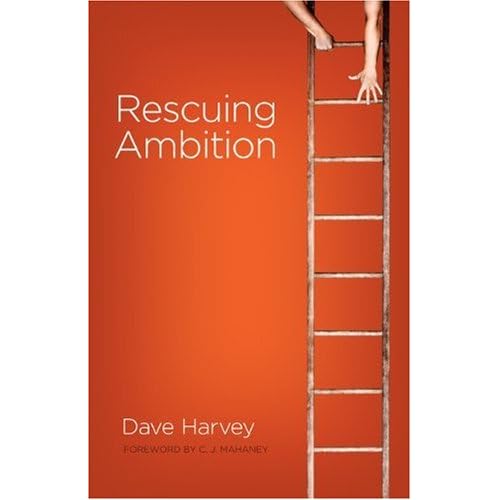 My friend Dave Harvey is coming out with another great book. Here is an intro from the Amazon site:
Go to Amazon here to pre-order.This pioneering book rescues ambition from suspicion by putting it to work for the glory of God.
Ambition has developed a reputation synonymous with the love of earthly honor and fame hunting. As a result, the organ of ambition—the God-implanted drive to improve, produce, develop, and create—is neglected and well on its way to paralysis. For some Christians, dreams are numbed. For others, there are no dreams; life just happens. One thing is certain: ambition needs help.
Dave Harvey is calling for a rescue. He wants to snatch ambition from the heap of failed motivations and put it to work for the glory of God. To understand our ambition, we must understand that we are on a quest for glory. Where we find glory determines the success of our quest. With his transparent humor and conversational tone, Harvey expounds on insights from Scripture and everyday life as he calls readers to reach further and dream bigger for the glory of God.
Wednesday, December 02, 2009
The Purpose of "A Christmas Carol"
Just read a great article on the original context to Dickens' "A Christmas Carol". Bottom line, Charles Dickens wrote this classic and touching Christmas story not that we would wax nostalgic about old-fashioned Christmases but that our hearts would be stirred to give generously to the poor and thus "keep Christmas" well.
A question for us to consider: If Scrooge were alive today what sort of reforms would he make to keep Christmas well? How can we keep Christmas in terms of charity for needy folks?
Perhaps part of how we can celebrate Christmas this year is in giving to the needy. Here are someworthy causes to help us keep Christmas:
A question for us to consider: If Scrooge were alive today what sort of reforms would he make to keep Christmas well? How can we keep Christmas in terms of charity for needy folks?
Perhaps part of how we can celebrate Christmas this year is in giving to the needy. Here are someworthy causes to help us keep Christmas:
- Somebody Cares New England
- Five Talents
- Compassion International
- Hands & Feet Project
- Blood:Water Mission
Wednesday, November 25, 2009
Need Some Good Advent Readings?
Are you looking for some good Advent devotionals? I came across this one from the Confederation of Reformed Evangelical Churches. It looks good. You can access it here.
HT: Nancy Wilson
HT: Nancy Wilson
Why Do You Go to Church?
Jeff Purswell has an excellent post on the biblical perspective on "going to church". Check out this excerpt:
"But you have come to Mount Zion and to the city of the living God, the heavenly Jerusalem, and to innumerable angels in festal gathering, and to the assembly of the firstborn who are enrolled in heaven, and to God, the judge of all, and to the spirits of the righteous made perfect, and to Jesus, the mediator of a new covenant, and to the sprinkled blood that speaks a better word than the blood of Abel." (Hebrews 12:22-24 ESV) ....
Sunday Morning
So back to your home church this upcoming Sunday. When you enter and the music begins, what are you more aware of? Is it the song set? the musicians? the mix? Does the worship band wow you? Does the routine bore you?
Or do you perceive something beyond all this?
Your church is one authentic manifestation of the entire people of God that right now is worshiping before the throne of God. That is the reality of new covenant worship. And when we begin to wrap our minds around that, there springs to mind a thousand reasons to rejoice, to praise, and to sing; and to renounce flippancy, self-display, selfishness, superficiality, sloppiness, and thoughtlessness.
Before the God who is a consuming fire, we don’t shuffle in casually. We don’t demand our artistic preferences. We don’t merely gather with our friends. We don’t merely sing together. As the people of God, we enter into the very presence of God. Encountering God in this way is the very nature of the church. By definition, to be the church is to gather in God’s presence and to worship God together. And when we begin singing, we join the glorious worship that takes place unceasingly before the throne of God.
This is true regardless of how we feel, who leads worship, what songs we sing, or how we think worship went. There is something incredible happening on Sunday morning!
Be the church and go to church. Something eternal is going on in there. Don’t miss it.
(Read more.....)
Sign the Manhattan Declaration
Are you concerned for our culture's misunderstanding of the right to life, the dignity of marriage and religious liberty? Then please consider signing the Manhattan Declaration.
This document winsomely, clearly and boldly presents a Christian worldview on these very important issues. The commitment elegantly communicated in this document is a vital one for every Christian dedicated to historic and biblical Christianity in a time of increasing confusion, controversy and conflict around Christian views of life, liberty and family.
Although some Christians might wrangle over the definition of "the gospel" in this document (see Tim Challis' post), I believe this is finding a tempest in a teacup. By signing the document you are in no way compromising either a Roman Catholic, Orthodox or Evangelical definition of the gospel. The document is constructed to allow Christians to unite over clear and historical Christian teaching on these social justice issues. Let's not lose an opportunity for forming a key and timely alliance because we would rather look for disagreement where none is intended.
I hope you are able to sign it!
Read the introduction below.
This document winsomely, clearly and boldly presents a Christian worldview on these very important issues. The commitment elegantly communicated in this document is a vital one for every Christian dedicated to historic and biblical Christianity in a time of increasing confusion, controversy and conflict around Christian views of life, liberty and family.
Although some Christians might wrangle over the definition of "the gospel" in this document (see Tim Challis' post), I believe this is finding a tempest in a teacup. By signing the document you are in no way compromising either a Roman Catholic, Orthodox or Evangelical definition of the gospel. The document is constructed to allow Christians to unite over clear and historical Christian teaching on these social justice issues. Let's not lose an opportunity for forming a key and timely alliance because we would rather look for disagreement where none is intended.
I hope you are able to sign it!
Read the introduction below.
The Manhattan Declaration
Christians, when they have lived up to the highest ideals of their faith, have defended the weak and vulnerable and worked tirelessly to protect and strengthen vital institutions of civil society, beginning with the family.
We are Orthodox, Catholic, and evangelical Christians who have united at this hour to reaffirm fundamental truths about justice and the common good, and to call upon our fellow citizens, believers and non-believers alike, to join us in defending them. These truths are:
- the sanctity of human life
- the dignity of marriage as the conjugal union of husband and wife
- the rights of conscience and religious liberty.
Inasmuch as these truths are foundational to human dignity and the well-being of society, they are inviolable and non-negotiable. Because they are increasingly under assault from powerful forces in our culture, we are compelled today to speak out forcefully in their defense, and to commit ourselves to honoring them fully no matter what pressures are brought upon us and our institutions to abandon or compromise them. We make this commitment not as partisans of any political group but as followers of Jesus Christ, the crucified and risen Lord, who is the Way, the Truth, and the Life. (Read More Here, Download PDF Here)
Thursday, October 22, 2009
A Clarification on Separation of God and Sports
In a recent post I wrote about the faulty idea and practice that you can somehow separate faith from the public arena - in this case, the sports arena. I cited an article written by Tom Krattenmaker from USA Today.
I want to clarify that Tom Krattenmaker is not calling for a "secular" sports arena, at least not directly or explicitly. As a matter of fact, Mr. Krattenmaker is fairly even-handed in his treatment of religious speech in the public arena. You can read his views on religious speech at Graduations here and his view on Intolerant Atheism here. You can learn more about Tom's views at his web site: tomkrattenmaker.com.
I do think Mr. Krattenmaker's article, And I'd Like to Thank God Almighty, unfairly and narrow-mindedly characterizes historic orthodox Christian beliefs and can be understood as a call to "secularization" of sports. But I wanted you to know that Mr. Krattenmaker is more of a friend of free-speech and overt religious convictions than an enemy.
More of the dialogue characteristic of Mr. Krattenmaker's earlier articles will help us all better enjoy the blessings of a free and just society.
I want to clarify that Tom Krattenmaker is not calling for a "secular" sports arena, at least not directly or explicitly. As a matter of fact, Mr. Krattenmaker is fairly even-handed in his treatment of religious speech in the public arena. You can read his views on religious speech at Graduations here and his view on Intolerant Atheism here. You can learn more about Tom's views at his web site: tomkrattenmaker.com.
I do think Mr. Krattenmaker's article, And I'd Like to Thank God Almighty, unfairly and narrow-mindedly characterizes historic orthodox Christian beliefs and can be understood as a call to "secularization" of sports. But I wanted you to know that Mr. Krattenmaker is more of a friend of free-speech and overt religious convictions than an enemy.
More of the dialogue characteristic of Mr. Krattenmaker's earlier articles will help us all better enjoy the blessings of a free and just society.
Wednesday, October 21, 2009
The End of Secularism
Another good discussion on the fallacy of "secularism". Here are some excerpts:
The Clothed Public SquareRead the whole article here. Or, get the book here.Hunter Baker was once a secularist. He believed in God while attending Florida State University, but he had no room for him outside of baptisms, weddings, and funerals. "If someone started talking about Jesus, it was like they were talking about their bathroom habits," Baker says. "That's how secularists feel, and they wish we would stop using religious language because it makes them uncomfortable." Now the Houston Baptist University political science professor is speaking up about the dangers of secularism. Christianity Today online editor Sarah Pulliam spoke with Baker about his new book, The End of Secularism (Crossway). ....
Secularism goes a lot further than the separation of church and state. Instead of saying that these things have to be institutionally separate, secularism says that religion has to be privatized and taken out of public life. Secularists argue that if we stop talking about God, we will create greater social harmony. But religion is not a hobby. To act as though God doesn't exist is fundamentally dishonest.
Second, it's unfair. [According to secularists,] you have Christianity, Buddhism, Hinduism, Islam, Mormonism, all of which orbit the sun of secularism. That's utterly fallacious. Secularism is really a competing orthodoxy. And if that's the case, why should one of these competitors be allowed to declare itself the umpire?
Separation of Church and Sport
 Once again, another fallacious appeal to separate "religion" from "secular" life in Tom Krattenmaker's article, And I'd like to thank God Almighty, appearing in USA Today.
While someone might argue persuasively for a humbler, gentler and more respectful advocacy of Christianity in sports it is impossible and fallacious to think we can somehow separate people's world views from what they think, say and do in the sports arena or any other context. Too often these appeals to separate "religion" from the public arena are just veiled attempts (even if unconsciously) to promote a simplistic humanistic worldview in the public arena to the exclusion of any other perspective.
I believe the better approach is a respectful and intelligent tolerance that fully allows divergent views to be freely expressed within the bounds of basic commonly held beliefs and values. I believe a thoroughly biblical Christianity is the best foundation for such an environment.
Read a good discussion of the sports article here. Also read a previous post on the fallacy of a "secular" view here.
Collision: Atheism vs. Christianity
I highly recommend watching the movie, "Collision." It is a documentary/debate on the diverse world views of Atheism and Christianity by some very articulate and winsome proponents of their views, Christopher Hitchins for Atheism and Douglas Wilson for Christianity.
Check out a recent sample of their debate on the Huffington Post:
Check out this trailer:
Check out a recent sample of their debate on the Huffington Post:
Religion Is AbsurdRead the whole thing.
by Christopher Hitchens
Religion will always retain a certain tattered prestige because it was our first attempt as a species to make sense of the cosmos and of our own nature, and because it continues to ask "why". Its incurable disability, however, lies in its insistence that the answer to that question can be determined with certainty on the basis of revelation and faith.....
This absurd belief would not even deserve to be called quixotic if it had not inspired masterpieces of art and music and architecture as well as the most appalling atrocities and depredations. The great cultural question before us is therefore this: can we manage to preserve what is numinous and transcendent and ecstatic without giving any more room to the superstitious and the supernatural. (For example, can one treasure and appreciate the Parthenon, say, while recognizing that the religious cult that gave rise to it is dead, and was in many ways sinister and cruel?) A related question is: can we be moral and ethical in our thoughts and actions without the servile idea that our morals are dictated to us by a supreme entity?
If Moses and Jesus and Mohammed had never existed -- let alone Joseph Smith or Mary Baker Eddy or Kim Jong Il or any of the other man-made prophets or idols -- we would still be faced with precisely the same questions about how to explain ourselves and our lives, how to think about the just city, and how to comport ourselves with our fellow-creatures. The small progress we have made so far, from the basic realization that diseases are not punishments to the noble idea that as humans we may even have "rights", is due to the exercise of skepticism and doubt, and to the objective scrutiny of hard evidence, and not at all to faith or certainty. The real "transcendence", then, is the one that allows us to shake off the notion of a never-dying tyrannical father-figure, with its unconsoling illusion of redemption by human sacrifice, and assume our proper proportion as people condemned to be free, and able to outgrow the fearful tutelage of a supreme supervisor who does not forgive us the errors he has programmed us to make.Atheists Suck at Being Atheists
by Pastor Douglas WilsonFrom the perspective of a Christian, the refusal of an atheist to be a Christian is dismaying, but it is at least intelligible. But what is really disconcerting is the failure of atheists to be atheists. That is the thing that cries out for further exploration.
We can understand a cook who sets out to prepare a reduction sauce, having it simmer on the stove for three days. But what we shouldn't get is the announcement afterwards that he has prepared us a soufflé. The atheistic worldview is nothing if not inherently reductionistic, whether this is admitted or not. Everything that happens is a chance-driven rattle-jattle jumble in the great concourse of atoms that we call time. Time and chance acting on matter have brought about, in equally aimless fashion, the 1927 New York Yankees, yesterday's foam on a New Jersey beach, Princess Di, the arrangement of pebbles on the back side of the moon, the music of John Cage, the Fourth Crusade, and the current gaggle representing us all in Congress.
If the universe actually is what the materialistic atheist claims it is, then certain things follow from that presupposition. The argument is simple to follow, and is frequently accepted by the sophomore presidents of atheist/agnostic clubs at a university near you, but it is rare for a well-published atheistic leader to acknowledge the force of the argument. To acknowledge openly the corrosive relativism that atheism necessarily entails would do nothing but get the chimps jumping in the red states. To swallow the reduction would present serious public relations problems, and drive Fox News ratings up even further. Who needs that?
If the atheist is right, then I am not a Christian because I have mistaken beliefs, but am rather a Christian because that is what these chemicals would always do in this arrangement and at this temperature. The problem is that this atheistic assumption does the very same thing to the atheist's case for atheism. The atheist gives us an account of all things which makes it impossible for us to believe that any account of all things could possibly be true. But no account of things can be tenable unless it provides us with the preconditions that make it possible for our "accounting" to represent genuine insight. Atheism fails to do this, and the failure is a spectacular one. Nor does atheism allow us to have any fixed ethical standard, or the possibility of beauty.
The documentary is now available from Amazon.
Check out this trailer:
Introducing Dave Harvey

I am very jazzed to see that Dave Harvey will start contributing to CJ Mahaney's blog, "view from the cheap seats & other stuff."
Dave is the author of When Sinners Say “I Do”: Discovering the Power of the Gospel for Marriage (Shepherd, 2007). This is one of the best books on marriage I have seen!
Dave is a good friend of mine and a wise and Godly pastor. He is in charge of church planting for Sovereign Grace Ministries. He is also very funny.
He recently wrote his first post. Check out this excerpt:
Because we love proclaiming the gospel, Sovereign Grace Ministries created a new role and asked me to fill it. We’re not big on titles around here so I’m the “person-responsible-for-church-planting, international-expansion-and-church-care-in-Sovereign-Grace.” People typically start yawning about halfway through my title, so I often grab attention by also throwing in “bomb disposal.”
I live in Philadelphia, home of the world champion Phillies and some pretty awesome cheesesteaks. If you don’t know what a cheesesteak is, then eating one someday should immediately go on your prayer list. Many young men feel called to plant churches in Philly after eating one.
But I digress. .....
Sovereign Grace Ministries defines success partly by planting gospel-centered churches. It is so important to us that we dedicate an enormous amount of time, training, resources, and personnel to it. We’ve been doing it for 25 years…it’s in our DNA, our genes, our blood, it’s…well, you get the picture. But here’s the neat thing: It still feels like we are just getting started. There’s still so much to do, so much to learn. And then we’ve got to effectively transfer the whole thing to the next generation so that they can continue the mission in strength.
I hope this is important to you as well. But sheer enthusiasm is not enough. We need to understand from God’s Word why we as a ministry are called to plant and build gospel-centered local churches around the world.
Wow, I get excited just writing about this stuff. And I hope my blog contribution will encourage those of you with the same burden for church planting.
Next time we’ll get started by answering the obvious and foundational question: Why plant churches in the first place?
So log on, grab a cheesesteak and join me next time.
If you have a couple minutes check out his full post here.
Looking forward to more!
Friday, October 09, 2009
Domesticating God
Preparing to preach on 1 Cor. 1:18-25 in relationship to trusting God. DA Carson has been very helpful in this regard. Here is a notable quote..
"Our self-centeredness is deep. It is so brutally idolatrous that it tries to domesticate God himself. In our desperate folly we act as if we can outsmart God, as if he owes us explanations, as if we are wise and self-determining while he exists only to meet our needs."And from the word of God:
DA Carson, The Cross and Christian Ministry, p. 15
"For the word of the cross is folly to those who are perishing, but to us who are being saved it is the power of God. For it is written,'I will destroy the wisdom of the wise, and the discernment of the discerning I will thwart.'Where is the one who is wise? Where is the scribe? Where is the debater of this age? Has not God made foolish the wisdom of the world?
For since, in the wisdom of God, the world did not know God through wisdom, it pleased God through the folly of what we preach to save those who believe. For Jews demand signs and Greeks seek wisdom, but we preach Christ crucified, a stumbling block to Jews and folly to Gentiles, but to those who are called, both Jews and Greeks, Christ the power of God and the wisdom of God. For the foolishness of God is wiser than men, and the weakness of God is stronger than men."
1 Corinthians 1:18-25 (ESV)
Wednesday, October 07, 2009
What Is A Secular Education?
Something I've been pondering for a while. Let me know what you think.....
There is an idea that is commonly held and even vehemently defended in our culture. People might even scoff if you disagree. They will perhaps quote supreme court rulings and excerpts from the constitution as well. The idea is this, that the only legal and proper education for public schools is a "secular" education.
Now this whole idea of "secular" living not only influences our view of education but really our view of everything in the public sphere - politics, community, neighborly talk, relationships at work etc.. "Keep your religion to yourself - that's a private thing." We all assume that life in the public sphere must be secular if we are to get along and coexist as good citizens. While I'm all for getting along and coexisting as good citizens I think that the idea of a "secular" realm is inherently contradictory. I believe a secular view is inherently religious and therefore the idea of a "secular" education violates the first amendment clause that prohibits government sanction of any particular religious view.
Webster defines "secular" as 1 a : of or relating to the worldly or temporal
In order to assume that there are ideas and actions that are secular, not overtly religious, you must assume that there is the ability to divorce ideas and actions from a greater reality than that which is immediately and apparently at hand. So at the core of the secular perspective is the assumption that there is a realm that can somehow be limited to merely the immediate and pragmatic experience of the individual or community. In this place, functionally and hypothetically, there is no God, there is no transcendent truth, there is really nothing more than the individual's or group's experience.
But how do we evaluate that experience? What is it? What constitutes the difference between a "spiritual" experience and a "secular"? What is a group? What is an individual? What is right and wrong? How do we determine it? If secular is the realm with no God, what is God? Where and how is there no God? How do I determine how to interact in such a realm? What are my rights? What are the groups rights? What is a "right" anyhow? How do we get that concept? What is "is"?
Do you see what sort of trouble we get into when we try to carve out a place called "secular"?
I would submit that there is no such thing as a "secular" realm. Instead, we have used this as camouflage to cover what functionally is a state-sponsored religion derived from an increasingly abandoned Enlightenment view of the world that is more-or-less bound to the assumption that the self (whatever that may be) is the ultimate determiner of reality and thus the spiritual center of the universe.
And if this view is the central commitment of our education system aren't we proselytizing our children when we base their education on a "secular" worldview? Is not this a violation of the establishment and free exercise clause of the First Amendment?
Is there a way forward? I think so- so did Abraham Kuyper - that's for another blog.
There is an idea that is commonly held and even vehemently defended in our culture. People might even scoff if you disagree. They will perhaps quote supreme court rulings and excerpts from the constitution as well. The idea is this, that the only legal and proper education for public schools is a "secular" education.
Now this whole idea of "secular" living not only influences our view of education but really our view of everything in the public sphere - politics, community, neighborly talk, relationships at work etc.. "Keep your religion to yourself - that's a private thing." We all assume that life in the public sphere must be secular if we are to get along and coexist as good citizens. While I'm all for getting along and coexisting as good citizens I think that the idea of a "secular" realm is inherently contradictory. I believe a secular view is inherently religious and therefore the idea of a "secular" education violates the first amendment clause that prohibits government sanction of any particular religious view.
Webster defines "secular" as 1 a : of or relating to the worldly or temporal
In order to assume that there are ideas and actions that are secular, not overtly religious, you must assume that there is the ability to divorce ideas and actions from a greater reality than that which is immediately and apparently at hand. So at the core of the secular perspective is the assumption that there is a realm that can somehow be limited to merely the immediate and pragmatic experience of the individual or community. In this place, functionally and hypothetically, there is no God, there is no transcendent truth, there is really nothing more than the individual's or group's experience.
But how do we evaluate that experience? What is it? What constitutes the difference between a "spiritual" experience and a "secular"? What is a group? What is an individual? What is right and wrong? How do we determine it? If secular is the realm with no God, what is God? Where and how is there no God? How do I determine how to interact in such a realm? What are my rights? What are the groups rights? What is a "right" anyhow? How do we get that concept? What is "is"?
Do you see what sort of trouble we get into when we try to carve out a place called "secular"?
I would submit that there is no such thing as a "secular" realm. Instead, we have used this as camouflage to cover what functionally is a state-sponsored religion derived from an increasingly abandoned Enlightenment view of the world that is more-or-less bound to the assumption that the self (whatever that may be) is the ultimate determiner of reality and thus the spiritual center of the universe.
And if this view is the central commitment of our education system aren't we proselytizing our children when we base their education on a "secular" worldview? Is not this a violation of the establishment and free exercise clause of the First Amendment?
Is there a way forward? I think so- so did Abraham Kuyper - that's for another blog.
Tuesday, October 06, 2009
Creativity and Congregational Worship
Watch this interview of CJ Mahaney and Bob Kauflin on the use of creativity in corporate worship- some very helpful cautions and instruction.
Monday, September 28, 2009
Four Views on Christianity and Culture
I came across an excellent discussion by Ray Pennings on four contemporary views of how Christians are to interact with the world. Here are some excerpts:
HT: Kevin DeYoung
You can check out the whole discussion here...... In my mind, there are at least four distinct approaches evident in Reformed circles today, each of which brings some perspective to the tension that this symposium seeks to address.Neocalvinism focuses on the comprehensiveness of the gospel claim. "Every square inch" belongs to Christ, and the full effects of the cross—as fully conquering sin, including its effects in the groaning creation—are emphasized. .... That means challenging the presuppositions of secular reasoning and working carefully with both the books of creation and revelation.
The "two kingdom perspective" .. brings at least two valuable insights to the conversation. Negatively, it warns against the hubris that sometimes can accompany an attempt to define "the" Christian position on various contemporary issues. ... Positively, it brings a very strong ecclesiology into the conversation, emphasizing the calling of believers to focus on their place in the church and the bride of Christ, and to emphasize the transcendence of the gospel.
Neopuritans (which I prefer as a term to describe that group which Time magazine described as New Calvinists) focus on the sovereignty of God and the glory of God.... this perspective results in an approach that is more individualistic than corporate, focuses more extensively on responding to the needs of our neighbours through the diaconal ministry of the church, and relies on being an example, resisting cultural trends and intentionally working towards a Christian counter-culture.
"Old Calvinism".... One example of this approach is John MacArthur, who has essentially come to the conclusion that engaging the city inevitably leads the church to worldliness and that when the church attempts to engage the culture, the culture is usually more effective at influencing the church.... Promoting godly living and the fruits of the Spirit is a mission "far more good and profitable to men than any amount of social and political activism . . . [Christians] are content very much to let the worldly people deal with the worldly things of this world."
So to summarize the discussion within Reformed circles today: The neocalvinist says the fundamental presuppositions underlying the debate need to be changed if we are to have meaningful engagement. The two kingdom perspective responds that it won't happen; when we try to engage in discussion, we end up calling things Christian that really aren't, resulting in pride and a misrepresentation of the gospel. The neopuritans say that that is why we should avoid a systemic approach; we should focus more on the individual needs of our neighbors and show them, both in ministries of mercy as well as by positive examples, that faith makes a difference. The Old Calvinists say that in all of this activity, we are losing our focus and getting dirty as we dig around in the garbage cans of culture to retrieve a penny or two of value from the bottom. We and our culture need heart-surgery, not band-aids.
Framing the camps in this way can emphasize the gaps and overlook the significant overlap that in practice one finds as people seek to balance their response to the practical tension that can emerge between gospel proclamation and seeking the peace of the city. I think more work needs to be done in developing a coherent public theology. I believe such a theology needs to be rooted in orthodox doctrine (truth matters, and cultural engagement that focuses on activity without core content inevitably leads astray); have a robust worldview that answers the questions our neighbours are asking (in other words, is less concerned about an agenda than responding to the needs and questions of those around us); has an ethic of integrity (our example is an important part of our witness and the institutional church with her offices must be as a bright light and example); and is lived with a pilgrimage spirit (which probably means more emphasis on the doctrines of providence and eschatology as everyday realities in the life of the believer.)
HT: Kevin DeYoung
Thursday, September 24, 2009
Thoughts on Two Kingdom Theology vs. Neo-Kuyperism
I have been reading a biography of Abraham Kuyper and digging deeper into his theology and philosophy. The more I read the more I like what he has to say and what he did.
Recently, Kevin DeYoung and some of the guys at the White Horse Inn debated the appeal of the Two Kingdom world view versus the Neo-Kuperian world view. Both views have value and biblical merit. See Justin Taylor's discussion for a good exchange among commentators.
I can't promise to add anything to their discussion. But, with the hope of helping us think a little more through these important ideas....my thoughts.
While I like aspects of the Two Kingdom approach I believe it has some serious drawbacks. Here are some thoughts on the advantages and drawbacks of the Two Kingdom view:
Advantages:
Drawbacks:
I am eager to think more through this more and hear your perspectives. What do you think?
Recently, Kevin DeYoung and some of the guys at the White Horse Inn debated the appeal of the Two Kingdom world view versus the Neo-Kuperian world view. Both views have value and biblical merit. See Justin Taylor's discussion for a good exchange among commentators.
I can't promise to add anything to their discussion. But, with the hope of helping us think a little more through these important ideas....my thoughts.
While I like aspects of the Two Kingdom approach I believe it has some serious drawbacks. Here are some thoughts on the advantages and drawbacks of the Two Kingdom view:
Advantages:
- It is a good understanding in wrestling with the reality that the elect are also exiles living in a world largely opposed to the reign of God.
- It helps protect the church from forgetting its chief priority of proclaiming Christ and displaying the fruit of the gospel first and foremost.
- It allows for participation in the realm of the world, where we often see the work of common grace that is distinct from true kingdom work (it lacks true acknowledgment of Christ as King ie. good government, friendly neighbors, public charities etc.).
- It keeps a healthy tension between the already and the not yet in our eschatology.
Drawbacks:
- It can lend itself to a neo-Gnosticism where our spirituality can be disconnected with the nitty-gritty of life lived in a body that dwells in a world that has cultural, economic, social, civic and relational realities that are intimately related to the spiritual.
- It can lend itself to an apathetic view of the world and the isolation of the Church from society. Christianity is a comprehensive worldview that is centered on Christ but finds application in every nook and cranny of life, both in a fallen world and in the future re-created world.
- It can seem to excuse Christians and Christian leaders from thinking through the particulars of how a Christian is to live in the world because of the inherent difficulty in applying gospel truth to the complexities of life and culture. While there are inherent dangers with any church advocating how to shop or how to invest in stocks or which political party to support or what art forms to promote, this is no reason for separating the realm of the church and the world in this way. We do not wash our hands of the application of the reign of Christ to the nitty-gritty because the issues can become too complicated. We must think biblically about every arena of life. Certainly we must be humble and admit we are culturally biased in our applications, but this is no reason for neglect. "There is a lion in the streets" is the excuse of the sluggard. The reign of Christ extends to all things. We must humbly and diligently seek to apply His truth in all arenas of life even if it means coming up with some messy answers at times.
- It seems where it has been embraced it has evidenced, to some degree, the negative effects of the previous three tendencies (ie. Lutheran & Mennonite vs. much of English, Dutch and American evangelicalism). Certainly Neo-Kuyperism has its drawbacks (a subject of a future post) but humble truthful comprehensive Gospel-centered activism, even with its misapplications and messiness seems to have a healthier legacy than the Two Kingdoms approach.
I am eager to think more through this more and hear your perspectives. What do you think?
Tuesday, September 22, 2009
Guaranteed by God - Romans 8:18-39
I have been studying Romans 8:18-39 in preparation for Sunday. Check out this wordle of this passage from the ESV.

Go to Wordle to see more.
Go to Wordle to see more.
The Sluggard
Check out this poem by Isaac Watts entitled "The Sluggard" drawn from the book of Proverbs. God grant us wisdom to avoid the way of the sluggard!
'Tis the voice of the sluggard; I heard him complain,
"You have waked me too soon, I must slumber again."
As the door on its hinges, so he on his bed,
Turns his sides and his shoulders and his heavy head.
"A little more sleep, and a little more slumber;"
Thus he wastes half his days, and his hours without number,
And when he gets up, he sits folding his hands,
Or walks about sauntering, or trifling he stands.
I pass'd by his garden, and saw the wild brier,
The thorn and the thistle grow broader and higher;
The clothes that hang on him are turning to rags;
And his money still wastes till he starves or he begs.
I made him a visit, still hoping to find
That he took better care for improving his mind:
He told me his dreams, talked of eating and drinking;
But scarce reads his Bible, and never loves thinking.
Said I then to my heart, "Here's a lesson for me,"
This man's but a picture of what I might be:
But thanks to my friends for their care in my breeding,
Who taught me betimes to love working and reading.
by Isaac Watts
Tuesday, September 15, 2009
Parenting Resources
I recently heard a message by Dave Harvey that I would put on my list of the top 25 messages I've ever heard. It was entitled, "Parenting in Weakness" and it was an analysis and application of 2 Cor. 12 to parenting. You don't want to miss this one.
Go to Monergism to download an MP3: "Parenting in Weakness", 2 Cor 11:30-12:10, Dave Harvey.
You might want to check out some of the other excellent teaching on parenting on Monergism. Go to Monergism's Section on Parenting here.
Enjoy!
Go to Monergism to download an MP3: "Parenting in Weakness", 2 Cor 11:30-12:10, Dave Harvey.
You might want to check out some of the other excellent teaching on parenting on Monergism. Go to Monergism's Section on Parenting here.
Enjoy!
Saturday, September 05, 2009


The Shack
Sorry for the summer respite from blogging.....
Something I've wanted to do for a while is write a review of The Shack by William Young. I read it this summer and enjoyed many aspects of it.
Something I've wanted to do for a while is write a review of The Shack by William Young. I read it this summer and enjoyed many aspects of it.
- It is a gripping story that forces us to address some heart-wrenching issues that are very real for many folks.
- It warmly portrays the compassion and tenderness of God.
- It communicates the nearness of God to us amidst our struggles.
- It does a good job of making us wrestle with the mystery of evil.
- It attempts to show how God might resolve our questions in a way that is partially faithful to scripture.
- It neglects to adequately portray the unfathomable glory and wisdom of God that is the ultimate answer for our questions about evil and suffering (see the book of Job).
- It downplays or even eliminates God's sovereignty over all of creation, even evil. (It is a scary thing if God is not in control - there are no guarantees in such a world.)
- It messes a bit too much with clear scriptural revelations of God for a 21st century version of God. (God as a woman, God as a cool older dude etc.)
- It does not emphasize the awesome holiness of God and our obvious and complete unworthiness before him. (see Is. 6 for a biblical encounter between God and a man.)
- It does not sufficiently highlight the ultimate resolution of evil in the suffering, death and resurrection of Jesus Christ.
Subscribe to:
Posts (Atom)