Saturday, May 01, 2010

Wondering About Church Planting in Sovereign Grace Ministries?

Dave Harvey has started a series of posts on church planting in Sovereign Grace Ministries. In classic Dave Harvey style he communciated some of the thinking on church planting in SGM. Here are some excerpts.

It can be awkward, but only sometimes. It happens in certain conversations with other church-planting guys whenever the topic turns to vision for the future. Usually it goes something like this.
Church-planting guy (not me): So how many churches would you Sovereign Grace guys like to plant over the next ten years?
Me: Mumble, mumble, mumble… (sounds of me stuffing chips in my mouth to avoid answering)
Church-planting guy: We’re believing God for thousands of churches planted over the next few months. We’re calling it maniacal multiplication. So how many churches do you guys have right now?
Me (having no more chips to protect me): About 80, or maybe it’s 90—I forget exactly.
CPG: Wow, that’s great. How long have you guys been planting?
Me: Since “We Are the World” came out.
CPG: Wow, that’s incredible.
Me: The first one.
CPG (doing math in his head): Oh…I’ll pray for you dude.
End of conversation. Awkward.
Let me say something at the outset here. First of all, I am so grateful that there are church-planting groups who love the Savior and love the lost so much that they are willing to take the risks and send men so that many gospel-preaching churches can be planted quickly. That’s bigtime faith! And make no mistake, it’s being hurled at a bigtime need. I have no doubt God will bless those efforts. But as much as I’d like to see Sovereign Grace churches so widely and thickly planted that you couldn’t spit from a freeway without hitting one, that isn’t what God is calling us to. At least for now.

When it came to church planting, what mattered to us was that real, solid, gospel-loving, local churches would bloom. Churches that had shared values, relational connection with each other, and common purpose. We didn’t want to plant churches and walk away from them, or have them walk away from us. We call ourselves a family of churches because that’s what we’ve been. We wanted to build slow and plant slow because we wanted every church to apply the gospel and be a healthy contributor to the mission of church planting for years to come. We’ve made tons of mistakes along the way, but that’s what we’ve tried to do.

I highly recommend you read the first installment and stay tuned.

Do You Know the "New Atheists"?

Justin Taylor has a post, entitled, 'What’s Right and What’s Wrong About the New Atheism?,' where he mentions what looks like a great book on the "New Atheists" - a group that will most likely grow in influence in our culture.

Take a few minutes to read his post here.

Friday, April 30, 2010

Keep Religion Out of Government?

Have you entered the fray about the National Day of Prayer?

As I listen to the wrangling about "separation of church and state" I am concerned for a major fallacy that seems to be the foundation of many folk's arguments (see USA Today and Comments on Franklin Graham's editorial in the Washington Post). The fallacy is that there is somehow the ability to separate religion from government. I believe this is impossible and not the concern of the authors and ratifiers of the first amendment.

Religion is really the cosmological and functional world view system one believes. We all have at least a functional world view system. If we didn't we couldn't operate in life. To be human is to have a world view, an understanding of our purpose and the general principles by which we live. Every human being has some sort of world view, from the most devout Christian to the most convinced agnostic to the most sincere pantheist. And, every government conceived by man operates under some religious assumptions.

So let's stop making the nonsense statement that we can separate religion from government. That's like saying we can separate breathing from being alive - we simply can't both be alive and not breath. Neither can we be alive and not be religious in some way. We can not have government and not have some religion shaping it.

I seems clear that the point the founding fathers were after was to keep the federal government from preferring a particular denomination or religious institution over another. They never meant to separate a belief in a supreme being from the foundation of our country. To do so unravels the very fabric of our government, a government predicated on a firm belief in a God who has created all men equal and endowed them with certain inalienable rights, a government reliant on a common and cohesive belief in a Supreme Judge. Without such an assumption the rest of what is asserted in the Declaration of Independence and all the founding documents comes undone.

So let's stop the nonsense understanding of "separation of church and state" as keeping "religion" out of government. Let's instead honor the wisdom of our founding fathers by seeking to be careful to not prefer one religious denomination or institution over another while maintaining a firm and foundational belief in a Supreme Being who has granted us and sustained for us the privilege of a just and representative government. We will sooner or later lose this privilege if we fail to honor the wisdom of our forefathers. 

A Government-sponsored non-partisan interfaith Theistic National Day of Prayer acknowledging our need for the help of the Supreme Being is not only constitutional but quintessential to our nation.

Thursday, April 22, 2010

King of Grace Church VBS 2010!

We are looking forward to this year's Vacation Bible School.

Come be a part of this July 12-16, King of Grace Church, 28 Chadwick St., Haverhill, Ma, 01835.

Register Here.

Saturday, April 17, 2010

Life-Changing Preaching

I heard David Platt for the first time at Together for the Gospel, 2010. Wow!

Check out these two messages below and let God use the preaching of David Platt to change your life!

David Platt: SBC Pastors Conference 2009 from Todd Thomas on Vimeo.


Friday, April 09, 2010

Phoebe Prince and the Golden Rule

I have been heart-broken at the tragic suicide of Phoebe Prince from South Hadley High School. Seeing a vibrant young girl so overcome with despair because of the wanton cruelty of others made me weep.

This tragedy coincides with our study of the Golden Rule as a church as we are learning about Kingdom Living from the Sermon on the Mount. If only Phoebe's classmates, her friends and her teachers and perhaps even her family had applied this simple and profound teaching everything might have been different.

And, if only I had done better at following this beautiful command when I was young. I am no better than any of the bullies and probably worse. I regret the many times I bullied others. God was merciful to keep me from participating in such a tragedy though I certainly have done things of equal wickedness.  And I continue to fall short myself in living the Golden Rule.

But there is hope and redemption. Christ himself fulfilled his own command in his beautiful life and his tragic death. His perfect life was offered as a sacrifice to pay the just penalty for those who willingly and knowingly spurn the justice and beauty of the golden rule and treat others cruelly. He died for bullies and young girls alike. He died that we might be forgiven for our horrible crimes and know perfect love.  And in knowing this forgiveness and perfect love, we might learn to love like Him - doing to others what we would want for ourselves. Would you look to Him to rescue you from your sins and lead you in His ways?

May God grant us wisdom and grace to live the Golden Rule as we look to the King and Savior who gave it to us, who shed his blood to cleanse us from disobeying it and who recreates us in Him to live it truly.

May God give us a someone like Pheobe to love and perhaps keep from such a tragedy.

As a side note: I was perplexed to see a post from Ethics Alarms focusing on how the Golden Rule is creating an unethical reaction to the situation. I would submit it would be better to say it is an incomplete application of the Golden Rule that might be functioning here.  Such an application of the Golden Rule is a violation of the Golden Rule in my opinion. I believe such a discussion is unhelpful.

Tuesday, April 06, 2010

Optical Illusion

Check this out. It is not a spiral but a series of concentric rings. Our minds take the information our eyes see and interpret - sometimes wrongly. Pretty amazing!
(Courtesy of Neatorama HT: Sarah H.)
Try squinting and looking at it - you might be able to see the rings.

Don't believe everything your senses and your mind tell you - they can be wrong. We need something better and more reliable than what our five senses tell us.....

Friday, April 02, 2010

Pray for Juárez

My friend Dave Harvey reports on one church's stand amidst the violence and turmoil of Juárez:
You may have seen reports of the murders of three people associated with the U.S. Consulate in Juárez, Mexico, earlier this month. ..As Mexico’s war on the drug cartels continues, the city of Juárez is embroiled in violence. On average, at least seven people have been murdered every day since 2009, including more than 500 murders since January. ...This ongoing social catastrophe has far-reaching effects. About 5,000 businesses have closed, and some estimate that as much as 15–20% of the city’s population has left. Those who remain face the daily threat of ruthless violence

Carlos Contreras..senior pastor of Iglesia Gracia Soberana de Cd. Juárez .. writes,
But there is good news also. The church in the city remains strong and has apparently become the only remaining source of hope for many people. We all pray and we pray a lot, and we pray boldly and we pray publicly for God to intervene in a miraculous way to change things and to do justice. But mostly we pray for revival and for the salvation of thousands.
Under the leadership of their pastoral team, Iglesia Gracia Soberana is taking the gospel to the streets. The most recent session of their Alpha class (an introductory class on the gospel) graduated 63 students, more than they’d ever had. The church is airing evangelistic programs on local TV. Earlier this month, 150 church members went to two busy intersections, handed out about 800 evangelistic tracts and about 200 New Testaments, and prayed for about 300 people. On Saturday they hit the streets again, handing out 6,000 invitations to church, 300 copies of the Gospel of John, and 200 New Testaments—and praying for 1,300 people.
You can read the whole article here.

Please pray for Juárez and Iglesia Gracia Soberana!
  • that God would grant wisdom and strength to Carlos Contreras and other pastors in Juárez.
  • that God would give sustaining grace to Iglesia Gracia Soberana and the other churches in this city.
  • that the gospel would be clearly preached and many would put their faith in Christ for forgiveness of sins.
  • that peace and justice would be restored to Juárez.
Check out this slide show of their prayer outreach:

Thursday, April 01, 2010

Wrestling with Biblical Studies?

Do you wrestle with studying God's word and preparing to preach?

Check out Andy Neselli's review of D.A. Carson's essay,  “The Trials of Biblical Studies” from
The Trials of Theology: Becoming a “Proven Worker” in a Dangerous Business (ed. Andrew J. B. Cameron and Brian S. Rosner; Fearn, Scotland: Christian Focus, 2010).

It look's like this is another very beneficial resource from our friend Dr. Carson.

Here are 2 of the five points Carson addresses followed by Andy's bulleted summaries. (You can read the whole review here.)

3. Five facets of pride

  • Your desire to be admired and recognized is dangerous.
  • The sheer joy you find in your work does not make you spiritually superior to people who work in other disciplines.
  • Your academic specialty in an area of biblical studies does not make you a superior pastor.
  • Knowing more about the Bible than most people you serve does not make you a superior person.
  • You may experience inverted pride (i.e., being threatened because you are insecure and jealous) if successful professionals in secular work think lightly of your job.

4. Pressures to manipulate Scripture

  • Avoid the pressure from the right: safe exegesis that reinforces your confessional group.
  • Avoid the pressure from the left: clever exegesis that makes you academically respectable.
  • Avoid the nonconformist pressure to reach independent conclusions on nearly everything.
  • Avoid the pressure to so focus on the history of interpretation that you never decide anything.
  • Instead, genuinely and patiently listen to the text with integrity.

New Atheism Smackdown

I came across Gayle Trotter's review of Mary Eberstadt's new book The Loser Letters. It is a Screwtape Letters type satire of the New Atheism. I can't wait to read it! Here is an excerpt:
The Loser Letters, Eberstadt’s first published work of fiction, draws on a long satirical tradition from Juvenal to The Screwtape Letters.  Eberstadt’s protagonist, a young woman named A. F. Christian (as in, “A Former Christian”), details the journey of her enlightened abandonment of her “cradle Dullness” (namely, her Christian faith) and her adaptation to atheism.  Christian writes excited, star-struck letters to the self-described so-called “Brights” of the New Atheism, in which she gushes about the Brights’ superiority while candidly evaluating the weaknesses that limit the New Atheism’s ability to win new converts.  With this device, Eberstadt delivers a gripping story line with a chilling twist at the end and, in the process, administers a smackdown of the New Atheism.
You can read the whole article here.

Wednesday, March 31, 2010

Gospel-Centered Sloganeering?

Came across a post from my friend Toby Kurth (HT: Justin Taylor). We often use the phrase, "gospel-centered" - may it be more about a lifelong pursuit of a Christ-centered  lifestyle than a shallow passing slogan! 

Check out what Toby says:
Gospel centrality must not be reduced to a slogan or way of defining yourself that does not really describe how you view the world. Gospel-centrality says that all of life and the Scriptures must be interpreted through the person and work of Jesus Christ. If gospel-centrality becomes just a way of speaking about ministry with certain buzzwords and catch phrases then it will have lost all meaning.

We do not drift towards gospel-centrality in our own lives or in our churches. It involves an active and frequent application of gospel truth to every situation we face. What makes me nervous are phrases like “Is he gospel-centered?” or “That is not a gospel-centered church.” Let’s not settle for shorthand. Being “gospel-centered” is a life-long endeavor, not a slogan. It is not the ability to recite a few well-crafted phrases; it is rather the commitment to continually turn away from defining yourself or your church in accordance with anything other than the person and work of Jesus Christ.
You can read the whole thing here.

Tuesday, March 30, 2010

"The Anti-Proverbs 31 Woman"

I enjoyed this post from Jared Mellinger, Senior Pastor of Covenant Fellowship Church. Sometimes we learn from the negative example.
“The Anti-Proverbs 31 Woman”
A substandard wife, who can find?
Her husband must micro-manage her,
And he hesitates to delegate anything to her.
She does him harm, not good,
All the days of her life.
She takes no delight in working,
And she labors with unwilling hands.
She finds a large number of tasks objectionable,
And carries them out with a languid footstep.
She looks first to her own interests in everything,
And avoids being inconvenienced at all costs.
Her household receives no attention,
And her children are neglected.
Her life orbits around herself,
She is lost in her own world.
She often sleeps in,
Her mouth feasts on the bread of idleness.
She is indecisive in decision making,
And her husband is a crutch in all things.
She rarely plans ahead,
And it brings chaos to her home.
She lives in the grip of fear,
Her closest companion is anxiety for the future.
Her husband is floundering in the gates,
Where he sits among the elders of the land.
She occasionally fears the Lord,
But cares far more about physical beauty.
She receives the fruit of her hands
When no one praises her in the gates.
Aren’t we glad that God’s grace and mercy overcomes our Anti-Proverbs 31, or Anti-Sermon on the Mount, or Anti-First Corinthians 13 tendencies so that we increasingly live conforming to God’s will and obedient to His word.

Christ's Sympathy

I hope you are encouraged by these thoughts from Octavius Winslow:

“Christ’s heart is a human heart, a sinless heart, a tender heart; a heart once the home of sorrow, once stricken with grief; once an aching, bleeding, mournful heart. Thus disciplined and trained, Jesus knows how to pity and to support those who are sorrowful and solitary. He loves to chase grief from the spirit, to bind up the broken heart, to staunch the bleeding wound, and to dry the weeping eye, to ‘comfort all that mourn.’ It is His delight to visit you in the dark night-season of your sorrow, and to come to you walking upon the tempestuous billows of your grief, breathing music and diffusing calmness over your scene of sadness and gloom.”

- Octavius Winslow, Evening Thoughts, January 10.

HT: Of First Importance

Thursday, March 18, 2010

Peter Hitchens, “The Rage Against God”

Peter Hitchens, the theistic brother of renowned atheist, Christopher Hitchens has written a book about his journey to Christianity, "The Rage Against God", available May 1 from Zondervan. Wikipedia has this on the new book:
"Peter Hitchens argues in his book that his brother's verdict on religion is misguided, and that faith in God is both a safeguard against the collapse of civilisation into moral chaos and the best antidote to the dangerous idea of earthly perfection through utopianism."
Here's a preview:


HT: Doug Wilson, Justin Taylor

Wednesday, March 17, 2010

The Greatest Danger Affecting American Evangelical Christianity?

I have been enjoying Mark Noll's insightful, though perhaps dated, analysis of the place of the mind among evangelicals. His quotations from Charles Malik were provocative.  Charles Malik was a Lebanese Christian  intellectual, professor and politician. Read some of his comments from a speech at Wheaton College below:
This is a solemn occasion. I must be frank with you: the greatest danger besetting American Evangelical Christianity is the danger of anti intellectualism. The mind as to its greatest and deepest reaches is not cared for enough. This cannot take place apart from profound immersion for a period of years in the history of thought and the spirit. People are in a hurry to get out of the university and start earning money or serving the church or preaching the Gospel. They have no idea of the infinite value of spending years of leisure in conversing with the greatest minds and souls of the past, and thereby ripening and sharpening and enlarging their powers of thinking.

The result is that the arena of creative thinking is abdicated and vacated to the enemy. Who among the Evangelicals can stand up to the great secular or naturalistic or atheistic scholars on their own terms of scholarship and research? Who among the Evangelical scholars is quoted as a normative source by the greatest secular authorities on history or philosophy or psychology or sociology or politics? Does your mode of thinking have the slightest chance of becoming the dominant mode of thinking in the great universities of Europe and America which stamp your entire civilization with their own spirit and ideas?
You can read the whole speech here.

The Story of St. Patrick


One version of the famous story of Patrick. Happy St. Patrick's Day! Enjoy!

The Conversion and Preaching of (St) Patrick in Ireland


An extract from the “History of the Reformation of the Sixteenth Century” by J. H. Merle d’Aubigné (1794-1872)


On the picturesque banks of the Clyde, not far from Glasgow, in the Christian village of Bonavern, now Kilpatrick, a little boy, of tender heart, lively temperament, and indefatigable activity, passed the earlier days of his life. He was born about the year 372 A. D., of a British family, and was named Succat.1 His father, Calpurnius, deacon of the church of Bonavern, a simple-hearted pious man, and his mother, Conchessa, sister to the celebrated Martin, archbishop of Tours,2 and a woman superior to the majority of her sex, had endeavoured to instil into his heart the doctrines of Christianity; but Succat did not understand them. He was fond of pleasure, and delighted to be the leader of his youthful companions. In the midst of his frivolities, he committed a serious fault.


Some few years later, his parents having quitted Scotland and settled in Armorica (Bretagne), a terrible calamity befell them. One day as Succat was playing near the seashore with two of his sisters, some Irish pirates, commanded by O’ Neal, carried them all three off to their boats, and sold them in Ireland to the petty chieftain of some pagan clan. Succat was sent into the fields to keep swine.3 It was while alone in these solitary pastures, without priest and without temple, that the young slave called to mind the divine lessons which his pious mother had so often read to him. The fault which he had committed pressed heavily night and day upon his soul: he groaned in heart, and wept. He turned repenting towards that meek Saviour of whom Conchessa had so often spoken; he fell at His knees in that heathen land, and imagined he felt the arms of a father uplifting the prodigal son. Succat was then born from on high, but by an agent so spiritual, so internal, that he knew not “whence it cometh or whither it goeth.” The gospel was written with the finger of God on the tablets of his heart. “I was sixteen years old,” said he, “and knew not the true God; but in that strange land the Lord opened my unbelieving eyes, and, although late, I called my sins to mind, and was converted with my whole heart to the Lord my God, who regarded my low estate, had pity on my youth and ignorance, and consoled me as a father consoles his children.”4


Such words as these from the lips of a swineherd in the green pastures of Ireland set clearly before us the Christianity which in the fourth and fifth centuries converted many souls in the British Isles. In after-years, Rome established the dominion of the priest and salvation by forms, independently of the dispositions of the heart; but the primitive religion of these celebrated islands was that living Christianity whose substance is the grace of Jesus Christ, and whose power is the grace of the Holy Ghost. The herdsman from the banks of the Clyde was then undergoing those experiences which so many evangelical Christians in those countries have subsequently undergone. “The love of God increased more and more in me,” said he, “with faith and the fear of His name. The Spirit urged me to such a degree that I poured forth as many as a hundred prayers in one day. And even during the night, in the forests and on the mountains where I kept my flock, the rain, the snow, and frost, and sufferings which I endured, excited me to seek after God. At that time, I felt not the indifference which now I feel: the Spirit fermented in my heart.”5 Evangelical faith even then existed in the British islands in the person of this slave, and of some few Christians born again, like him, from on high.


Twice a captive and twice rescued, Succat, after returning to his family, felt an irresistible appeal in his heart. It was his duty to carry the gospel to those Irish pagans among whom he had found Jesus Christ. His parents and his friends endeavoured in vain to detain him; the same ardent desire pursued him in his dreams. During the silent watches of the night he fancied he heard voices calling to him from the dark forests of Erin: “Come, holy child, and walk once more among us.” He awoke in tears, his breast filled with the keenest emotion.6 He tore himself from the arms of his parents, and rushed forth – not as heretofore with his playfellows, when he would climb the summit of some lofty hill – but with a heart full of charity in Christ. He departed: “It was not done of my own strength,” said he; “it was God who overcame all.”


Succat, afterwards known as Saint Patrick, and to which name, as to that of St Peter and other servants of God, many superstitions have been attached, returned to Ireland, but without visiting Rome, as an historian of the twelfth century has asserted.7 Ever active, prompt, and ingenious, he collected the pagan tribes in the fields by beat of drum, and then narrated to them in their own tongue the history of the Son of God. Erelong his simple recitals exercised a divine power over their rude hearts, and many souls were converted, not by external sacraments or by the worship of images, but by the preaching of the word of God. The son of a chieftain, whom Patrick calls Benignus, learnt from him to proclaim the Gospel, and was destined to succeed him. The court bard, Dubrach Mac Valubair, no longer sang druidical hymns, but canticles addressed to Jesus Christ. Patrick was not entirely free from the errors of the time; perhaps he believed in pious miracles; but generally speaking we meet with nothing but the gospel in the earlier days of the British church. The time no doubt will come when Ireland will again feel the power of the Holy Ghost, which had once converted it by the ministrations of a Scotchman.


1 In baptismo haud Patricum sed Succat a parentibus fuisse dictum. Usser. Brit. Eccl. Antiq. p. 428.


2 Martini Turonum archiepiscopi consanguineam. Ibid.


3 Cujus porcorum pastor erat. Ibid. p. 431.


4 Et ibi Dominus aperuit sensum incredulitatis meæ, ut vel sero remorarem delicta mea, et ut converterer toto corde ad Dominum Deum meum. Patr. Confess. Usser, 431.


Reference:
“HISTORY OF THE REFORMATION IN THE SIXTEENTH CENTURY,” by J. H. Merle d’Aubigné, 1846. French edition 1835. Published by Baker Book House (USA), reprinted from the edition issued in London in 1846. Vol 5, pp 679-680.

Thursday, March 11, 2010

Looking for a Good Daily Bible Devotional?

D.A. Carson's "For the Love of God" is probably the best daily devotional I know. And, it is now available via a blog from the Gospel Coalition.SWEET!

Read it here.

It is based on the Murray M'Cheyne daily bible reading plan and can be used to go through the whole bible in a year or two years.  I recommend the two-year approach for starters.

Wednesday, March 10, 2010

Do You Worry You Are Passing On A Wrong View of God to Your Kids?

Tony Reinke has an excellent post about passing on to our children a right view of God. 

He includes some suggestions CJ Mahaney made to a dad who is worried that he might pass on his own misunderstanding of God to his children instead of the right view of God.
  • Communicating your affection for them—and joy when you are with them—promotes both good and accurate thoughts about God.
  • Initiate time with them at both planned and spontaneous times. Don’t leave them with the impression that they get most of your attention when they disobey. Let them know you are so grateful for them and love being with them as much as possible.
  • Bless your children with many gifts in many forms! See Luke 11 again. Study your children in order to discern what gifts would genuinely bless them and then purpose to surprise them as often as possible.
  • Requiring appropriate obedience does not promote hard thoughts about God. This only happens when we do so in self-righteousness or anger.
  • Frequently preach the gospel to them (and not at them). Reveal to your children just how far God has gone to show his love for sinners like us.
Take a few minutes to read the whole article here.  I recommend it!

Saturday, March 06, 2010

'They Need to Be Liberated From Their God'

Check out this fascinating interview with Mosab Hassan Yousef, the son of Hamas founder Sheikh Hassan Yousef. He talks about his conversion to Christianity and his work for Israeli intelligence while a member of Hamas. He reports that he worked with Israeli intelligence to save lives on both sides. Listen to him speak about his conversion.
"I converted to Christianity because I was convinced by Jesus Christ as a character, as a personality. I loved him, his wisdom, his love, his unconditional love. I didn't leave [the Islamic] religion to put myself in another box of religion. At the same time it's a beautiful thing to see my God exist in my life and see the change in my life. I see that when he does exist in other Middle Easterners there will be a change." 
He also reports that the fundamental difficulty with Islam is that the God of Islam is not the right God.
"What matters is not whether my father is a fanatic or not, he's doing the will of a fanatic God. It doesn't matter if he's a terrorist or a traditional Muslim. At the end of the day a traditional Muslim is doing the will of a fanatic, fundamentalist, terrorist God. I know this is harsh to say. Most governments avoid this subject. They don't want to admit this is an ideological war. ..... The problem is not in Muslims...the problem is with their God. They need to be liberated from their God. He is their biggest enemy. It has been 1,400 years they have been lied to."
May God raise up millions of Middle Easterners who really know God and show it!  May they teach us in the West what it looks like when you really know God! May Christ reign over the Middle East in a way that shows the world who he really is - not some by-product of the West or corrupted icon of marauding Crusaders but something much better, purer, altogether different and glorious!

 أَبَانَا الَّذِي فِي السَّمَاوَاتِ لِيَتَقَدَّسِ اسْمُكَ.  لِيَأْتِ مَلَكُوتُكَ. لِتَكُنْ مَشِيئَتُكَ كَمَا فِي السَّمَاءِ كَذَلِكَ عَلَى الأَرْضِ

Wednesday, February 24, 2010

Do You Remember Getting Your "Bell Rung" in HS Football?

I remember getting "your bell rung" was a normal part of playing football. One time I popped my Riddell air-filled helmet. Another time I bent my facemask on another guys head during a kickoff. We called the kickoff team the "suicide squad" - for good reason. After I bent my facemask everything turned yellow and this load hum filled my ears - probably a concussion.

I am glad for the heightened awareness of concussions these days. The NFL and our local high schools as well are actively seeking to protect athletes from concussions. Hopefully, getting "your bell rung" will be a thing of the past for all athletes.

Check out these articles here:
Dangerous games: As dozens suffer concussions, awareness of risks grows .
N.F.L. Acknowledges Long-Term Concussion Effects

Can My Marriage Change if My Spouse Doesn't Change?

Some wisdom for improving your marriage from Winston Smith:


"Why do you see the speck that is in your brother's eye, but do not notice the log that is in your own eye? Or how can you say to your brother, ‘Let me take the speck out of your eye,’ when there is the log in your own eye? You hypocrite, first take the log out of your own eye, and then you will see clearly to take the speck out of your brother's eye."

Tuesday, February 23, 2010

Heard of Bible Arcing? It is very helpful!

Together for the Gospel

I am so looking forward to being at T4G with our guys, Jeff, Phil and David and many other friends.

And I'm looking forward to hearing from a man who greatly influenced my life - RC Sproul - a great husband and dad, bible teacher, theologian, football fan, golfer, ballroom dancer, outdoorsman and a funny guy.

Check out this video:

R.C. Sproul - Study Video from Together for the Gospel (T4G) on Vimeo.


And this:

Together for the Gospel: T4G 2010 Conference from Together for the Gospel (T4G) on Vimeo.

Saturday, February 20, 2010

Sermon on the Mount from Memory

We are in a series on the Sermon on the Mount entitled, "Kingdom Living".  Studying the Sermon on the Mount has been rich and rewarding.  Check out this recitation of the Sermon on the Mount from memory given by Pastor Trevin Wax. 
HT: Bruce Webb

Part 1:


Part 2:

Love in Marriage - A Follow-up to the Five Love Languages

In case anyone who read David Powlison's gracious critique of "Five Love Languages" might think him an armchair quarterback, please look at some of his excellent counsel for married couples.  I know few people who combine the biblical wisdom and gracious care that David displays while wisely discerning the good, bad and neutral of the broader counseling world. Check out the following and see what you think.
  1.  On Marital Intimacy, Part 1
  2.  On Marital Intimacy, Part 2
  3.  On Marital Intimacy, Part 3
  4. Making All Things New: Restoring Pure Joy to the Sexually Broken
  5. More Resources at Christian Counseling and Education Foundation


Thursday, February 18, 2010

The Five Love Languages

Justin Taylor has an excellent post reviewing the very popular book, "The Five Love Languages" by Gary Chapman. 

Here are some highlights:

Chapman’s model, Powlison argues, fails the class “Human Nature 101.”
Like all secular interpretations of human psychology (even when lightly Christianized), it makes some good observations and offers some half-decent advice (of the sort that self-effort can sometimes follow). But it doesn’t really understand human psychology. That basic misunderstanding has systematic distorting and misleading effects. Fallenness not only brings ignorance about how best to love others; it brings a perverse unwillingness and inability to love. It ingrains the perception that our lusts are in fact needs, empty places inside where others have disappointed us. The empty emotional tank construct is congenial to our fallen instincts, not transformative. It leaves what we instinctively want as an unquestionable good that must somehow be fulfilled. It not only leaves fundamental self-interest unchallenged, it plays to self-interest. . . .
Powlison goes on to contrast this perspective with the foreign “love language” of Christ:
The love of Christ speaks a “love language”—mercy to hellishly self-centered people—that no person can hear or understand unless God gives ears to hear. It is a language we cannot speak to others unless God makes us fluent in an essentially foreign language. We might say that the itch itself (an ear for God’s language) has to be created, because we live in such a stupor of self-centered itchiness. The love language model does not highlight those exquisite forms of love that do not “speak your language.” You and I need to learn a new language if we are to become fit to live with each other and with God. The greatest love ever shown does not speak the instinctively self-centered language of the recipients of such love. In fundamental ways, the love of Christ speaks contrary to your “love language” and “felt needs.” Does anyone naturally say, “I need You to rule me so I’m no longer ruled by what I want”? Does anyone naturally say, “For Your name’s sake, O LORD, pardon my iniquity for it is great” (Psalm 25:11)? Does anyone naturally say, “My greatest need is for mercy, and then for the wisdom to give mercy. I long for redemption. May Your kingdom come. Deliver us from evil”?
God’s grace aims to destroy the lordship of the five love languages, even while teaching us to speak the countless love languages with greater fluency.
 Please take 5 minutes to read the whole thing here.

While this book has some excellent insight into how people communicate love, it can be understood and practiced in a way very contrary to the Kingdom ethic of love we find in the Sermon on the Mount. King of Grace church is going through a series on the Sermon on the Mount entitled, "Kingdom Living".  Listen to the message on Kingdom love, "Be Perfect", here.

Friday, February 05, 2010

The Weight of Glory

It's been almost two months since my last blog - sorry! I guess it has been a very full two months. Lots of good things going on - full family life, helping my High-School age kids with homework, lots of wonderful pastoring stuff, Alpha, learning Hebrew, teaching Latin, and, I'm sure, some degree of just goofing off.

Anyhow - in preparation for preaching from Mt. 6:1-4 in our Sermon on the Mount series I was reading some CS Lewis. I think he had it right in many ways in his understanding of heavenly reward. ( BTW - I very much like Lewis but do not consider him entirely reliabletheologically.) Take about 15 minutes or so and read his excellent essay, "The Weight of Glory", available through the Doxa website.

Enjoy!

The essay is reproduced below from the Doxa site.


The Weight of Glory
by C.S. Lewis

Preached originally as a sermon in the Church of St Mary the Virgin, Oxford, on June 8, 1942: published in THEOLOGY, November, 1941, and by the S.P.C.K, 1942

If you asked twenty good men to-day what they thought the highest of the virtues, nineteen of them would reply, Unselfishness. But if you asked almost any of the great Christians of old he would have replied, Love. You see what has happened? A negative term has been substituted for a positive, and this is of more than philological importance. The negative ideal of Unselfishness carries with it the suggestion not primarily of securing good things for others, but of going without them ourselves, as if our abstinence and not their happiness was the important point. I do not think this is the Christian virtue of Love. The New Testament has lots to say about self-denial, but not about self-denial as an end in itself. We are told to deny ourselves and to take up our crosses in order that we may follow Christ; and nearly every description of what we shall ultimately find if we do so contains an appeal to desire. If there lurks in most modern minds the notion that to desire our own good and earnestly to hope for the enjoyment of it is a bad thing, I submit that this notion has crept in from Kant and the Stoics and is no part of the Christian faith. Indeed, if we consider the unblushing promises of reward and the staggering nature of the rewards promised in the Gospels, it would seem that Our Lord finds our desires, not too strong, but too weak. We are half-hearted creatures, fooling about with drink and sex and ambition when infinite joy is offered us, like an ignorant child who wants to go on making mud pies in a slum because he cannot imagine what is meant by the offer of a holiday at the sea. We are far too easily pleased.

We must not be troubled by unbelievers when they say that this promise of reward makes the Christian life a mercenary affair. There are different kinds of reward. There is the reward which has no natural connexion with the things you do to earn it, and is quite foreign to the desires that ought to accompany those things. Money is not the natural reward of love; that is why we call a man mercenary if he marries a woman for the sake of her money. But marriage is the proper reward for a real lover, and he is not mercenary for desiring it. A general who fights well in order to get a peerage is mercenary; a general who fights for victory is not, victory being the proper reward of battle as marriage is the proper reward of love. The proper rewards are not simply tacked on to the activity for which they are given, but are the activity itself in consummation. There is also a third case, which is more complicated. An enjoyment of Greek poetry is certainly a proper, and not a mercenary, reward for learning Greek; but only those who have reached the stage of enjoying Greek poetry can tell from their own experience that this is so. The schoolboy beginning Greek grammar cannot look forward to his adult enjoyment of Sophocles as a lover looks forward to marriage or a general to victory. He has to begin by working for marks, or to escape punishment, or to please his parents, or, at best, in the hope of a future good which he cannot at present imagine or desire. His position, therefore, bears a certain resemblance to that of the mercenary; the reward he is going to get will, in actual fact, be a natural or proper reward, but he will not know that till he has got it. Of course, he gets it gradually; enjoyment creeps in upon the mere drudgery, and nobody could point to a day or an hour when the one ceased and the other began. But it is just in so far as he approaches the reward that be becomes able to desire it for its own sake; indeed, the power of so desiring it is itself a preliminary reward

The Christian, in relation to heaven, is in much the same position as this schoolboy. Those who have attained everlasting life in the vision of God doubtless know very well that it is no mere bribe, but the very consummation of their earthly discipleship; but we who have not yet attained it cannot know this in the same way, and cannot even begin to know it at all except by continuing to obey and finding the first reward of our obedience in our increasing power to desire the ultimate reward. Just in proportion as the desire grows, our fear lest it should be a mercenary desire will die away and finally be recognized as an absurdity. But probably this will not, for most of us, happen in a day; poetry replaces grammar, gospel replaces law, longing transforms obedience, as gradually as the tide lifts a grounded ship.

But there is one other important similarity between the schoolboy and ourselves. If he is an imaginative boy he will, quite probably, be revelling in the English poets and romancers suitable to his age some time before he begins to suspect that Greek grammar is going to lead him to more and more enjoyments of this same sort. He may even be neglecting his Greek to read Shelley and Swinburne in secret. In other words, the desire which Greek is really going to gratify already exists in him and is attached to objects which seem to him quite unconnected with Xenophon and the verbs in ??. Now, if we are made for heaven, the desire for our proper place will be already in us, but not yet attached to the true object, and will even appear as the rival of that object. And this, I think, is just what we find. No doubt there is one point in which my analogy of the schoolboy breaks down. The English poetry which he reads when he ought to be doing Greek exercises may be just as good as the Greek poetry to which the exercises are leading him, so that in fixing on Milton instead of journeying on to Aeschylus his desire is not embracing a false object. But our case is very different. If a transtemporal, transfinite good is our real destiny, then any other good on which our desire fixes must be in some degree fallacious, must bear at best only a symbolical relation to what will truly satisfy.

In speaking of this desire for our own far- off country, which we find in ourselves even now, I feel a certain shyness. I am almost committing an indecency. I am trying to rip open the inconsolable secret in each one of you—the secret which hurts so much that you take your revenge on it by calling it names like Nostalgia and Romanticism and Adolescence; the secret also which pierces with such sweetness that when, in very intimate conversation, the mention of it becomes imminent, we grow awkward and affect to laugh at ourselves; the secret we cannot hide and cannot tell, though we desire to do both. We cannot tell it because it is a desire for something that has never actually appeared in our experience. We cannot hide it because our experience is constantly suggesting it, and we betray ourselves like lovers at the mention of a name. Our commonest expedient is to call it beauty and behave as if that had settled the matter. Wordsworth’s expedient was to identify it with certain moments in his own past. But all this is a cheat. If Wordsworth had gone back to those moments in the past, he would not have found the thing itself, but only the reminder of it; what he remembered would turn out to be itself a remembering. The books or the music in which we thought the beauty was located will betray us if we trust to them; it was not in them, it only came through them, and what came through them was longing. These things—the beauty, the memory of our own past—are good images of what we really desire; but if they are mistaken for the thing itself they turn into dumb idols, breaking the hearts of their worshippers. For they are not the thing itself; they are only the scent of a flower we have not found, the echo of a tune we have not heard, news from a country we have never yet visited. Do you think I am trying to weave a spell? Perhaps I am; but remember your fairy tales. Spells are used for breaking enchantments as well as for inducing them. And you and I have need of the strongest spell that can be found to wake us from the evil enchantment of worldliness which has been laid upon us for nearly a hundred years. Almost our whole education has been directed to silencing this shy, persistent, inner voice; almost all our modem philosophies have been devised to convince us that the good of man is to be found on this earth. And yet it is a remarkable thing that such philosophies of Progress or Creative Evolution themselves bear reluctant witness to the truth that our real goal is elsewhere. When they want to convince you that earth is your home, notice how they set about it. They begin by trying to persuade you that earth can be made into heaven, thus giving a sop to your sense of exile in earth as it is. Next, they tell you that this fortunate event is still a good way off in the future, thus giving a sop to your knowledge that the fatherland is not here and now. Finally, lest your longing for the transtemporal should awake and spoil the whole affair, they use any rhetoric that comes to hand to keep out of your mind the recollection that even if all the happiness they promised could come to man on earth, yet still each generation would lose it by death, including the last generation of all, and the whole story would be nothing, not even a story, for ever and ever. Hence all the nonsense that Mr. Shaw puts into the final speech of Lilith, and Bergson’s remark that the élan vital is capable of surmounting all obstacles, perhaps even death—as if we could believe that any social or biological development on this planet will delay the senility of the sun or reverse the second law of thermodynamics.

Do what they will, then, we remain conscious of a desire which no natural happiness will satisfy. But is there any reason to suppose that reality offers any satisfaction to it? “Nor does the being hungry prove that we have bread.” But I think it may be urged that this misses the point. A man’s physical hunger does not prove that that man will get any bread; he may die of starvation on a raft in the Atlantic. But surely a man’s hunger does prove that he comes of a race which repairs its body by eating and inhabits a world where eatable substances exist. In the same way, though I do not believe (I wish I did) that my desire for Paradise proves that I shall enjoy it, I think it a pretty good indication that such a thing exists and that some men will. A man may love a woman and not win her; but it would be very odd if the phenomenon called “falling in love” occurred in a sexless world.

Here, then, is the desire, still wandering and uncertain of its object and still largely unable to see that object in the direction where it really lies. Our sacred books give us some account of the object. It is, of course, a symbolical account. Heaven is, by definition, outside our experience, but all intelligible descriptions must be of things within our experience. The scriptural picture of heaven is therefore just as symbolical as the picture which our desire, unaided, invents for itself; heaven is not really full of jewelry any more than it is really the beauty of Nature, or a fine piece of music. The difference is that the scriptural imagery has authority. It comes to us from writers who were closer to God than we, and it has stood the test of Christian experience down the centuries. The natural appeal of this authoritative imagery is to me, at first, very small. At first sight it chills, rather than awakes, my desire. And that is just what I ought to expect. If Christianity could tell me no more of the far-off land than my own temperament led me to surmise already, then Christianity would be no higher than myself. If it has more to give me, I must expect it to be less immediately attractive than “my own stuff.” Sophocles at first seems dull and cold to the boy who has only reached Shelley. If our religion is something objective, then we must never avert our eyes from those elements in it which seem puzzling or repellent; for it will be precisely the puzzling or the repellent which conceals what we do not yet know and need to know.

The promises of Scripture may very roughly be reduced to five heads. It is promised, firstly, that we shall be with Christ; secondly, that we shall be like Him; thirdly, with an enormous wealth of imagery, that we shall have “glory”; fourthly, that we shall, in some sense, be fed or feasted or entertained; and, finally, that we shall have some sort of official position in the universe—ruling cities, judging angels, being pillars of God’s temple. The first question I ask about these promises is: “Why any of them except the first?” Can anything be added to the conception of being with Christ? For it must be true, as an old writer says, that he who has God and everything else has no more than he who has God only. I think the answer turns again on the nature of symbols. For though it may escape our notice at first glance, yet it is true that any conception of being with Christ which most of us can now form will be not very much less symbolical than the other promises; for it will smuggle in ideas of proximity in space and loving conversation as we now understand conversation, and it will probably concentrate on the humanity of Christ to the exclusion of His deity. And, in fact, we find that those Christians who attend solely to this first promise always do fill it up with very earthly imagery indeed—in fact, with hymeneal or erotic imagery. I am not for a moment condemning such imagery. I heartily wish I could enter into it more deeply than I do, and pray that I yet shall. But my point is that this also is only a symbol, like the reality in some respects, but unlike it in others, and therefore needs correction from the different symbols in the other promises. The variation of the promises does not mean that anything other than God will be our ultimate bliss; but because God is more than a Person, and lest we should imagine the joy of His presence too exclusively in terms of our present poor experience of personal love, with all its narrowness and strain and monotony, a dozen changing images, correcting and relieving each other, are supplied.

I turn next to the idea of glory. There is no getting away from the fact that this idea is very prominent in the New Testament and in early Christian writings. Salvation is constantly associated with palms, crowns, white robes, thrones, and splendour like the sun and stars. All this makes no immediate appeal to me at all, and in that respect I fancy I am a typical modern. Glory suggests two ideas to me, of which one seems wicked and the other ridiculous. Either glory means to me fame, or it means luminosity. As for the first, since to be famous means to be better known than other people, the desire for fame appears to me as a competitive passion and therefore of hell rather than heaven. As for the second, who wishes to become a kind of living electric light bulb?

When I began to look into this matter I was stocked to find such different Christians as Milton, Johnson and Thomas Aquinas taking heavenly glory quite frankly in the sense of fame or good report. But not fame conferred by our fellow creatures—fame with God, approval or (I might say) “appreciation’ by God. And then, when I had thought it over, I saw that this view was scriptural; nothing can eliminate from the parable the divine accolade, “Well done, thou good and faithful servant.” With that, a good deal of what I had been thinking all my life fell down like a house of cards. I suddenly remembered that no one can enter heaven except as a child; and nothing is so obvious in a child—not in a conceited child, but in a good child—as its great and undisguised pleasure in being praised. Not only in a child, either, but even in a dog or a horse. Apparently what I had mistaken for humility had, all these years. prevented me from understanding what is in fact the humblest, the most childlike, the most creaturely of pleasures—nay, the specific pleasure of the inferior: the pleasure a beast before men, a child before its father, a pupil before his teacher, a creature before its Creator. I am not forgetting how horribly this most innocent desire is parodied in our human ambitions, or how very quickly, in my own experience, the lawful pleasure of praise from those whom it was my duty to please turns into the deadly poison of self-admiration. But I thought I could detect a moment—a very, very short moment—before this happened, during which the satisfaction of having pleased those whom I rightly loved and rightly feared was pure. And that is enough to raise our thoughts to what may happen when the redeemed soul, beyond all hope and nearly beyond belief, learns at last that she has pleased Him whom she was created to please. There will be no room for vanity then. She will be free from the miserable illusion that it is her doing. With no taint of what we should now call self-approval she will most innocently rejoice in the thing that God has made her to be, and the moment which heals her old inferiority complex for ever will also drown her pride deeper than Prospero’s book. Perfect humility dispenses with modesty. If God is satisfied with the work, the work may be satisfied with itself; “it is not for her to bandy compliments with her Sovereign.” I can imagine someone saying that he dislikes my idea of heaven as a place where we are patted on the back. But proud misunderstanding is behind that dislike. In the end that Face which is the delight or the terror of the universe must be turned upon each of us either with one expression or with the other, either conferring glory inexpressible or inflicting shame that can never be cured or disguised. I read in a periodical the other day that the fundamental thing is how we think of God. By God Himself, it is not! How God thinks of us is not only more important, but infinitely more important. Indeed, how we think of Him is of no importance except in so far as it is related to how He thinks of us. It is written that we shall “stand before” Him, shall appear, shall be inspected. The promise of glory is the promise, almost incredible and only possible by the work of Christ, that some of us, that any of us who really chooses, shall actually survive that examination, shall find approval, shall please God. To please God...to be a real ingredient in the divine happiness...to be loved by God, not merely pitied, but delighted in as an artist delights in his work or a father in a son—it seems impossible, a weight or burden of glory which our thoughts can hardly sustain. But so it is.

And now notice what is happening. If I had rejected the authoritative and scriptural image of glory and stuck obstinately to the vague desire which was, at the outset, my only pointer to heaven, I could have seen no connexion at all between that desire and the Christian promise. But now, having followed up what seemed puzzling and repellent in the sacred books, I find, to my great surprise, looking back, that the connexion is perfectly clear. Glory, as Christianity teaches me to hope for it, turns out to satisfy my original desire and indeed to reveal an element in that desire which I had not noticed. By ceasing for a moment to consider my own wants I have begun to learn better what I really wanted. When I attempted, a few minutes ago, to describe our spiritual longings, I was omitting one of their most curious characteristics. We usually notice it just as the moment of vision dies away, as the music ends or as the landscape loses the celestial light. What we feel then has been well described by Keats as “the journey homeward to habitual self.” You know what I mean. For a few minutes we have had the illusion of belonging to that world. Now we wake to find that it is no such thing. We have been mere spectators. Beauty has smiled, but not to welcome us; her face was turned in our direction, but not to see us. We have not been accepted, welcomed, or taken into the dance. We may go when we please, we may stay if we can: “Nobody marks us.” A scientist may reply that since most of the things we call beautiful are inanimate, it is not very surprising that they take no notice of us. That, of course, is true. It is not the physical objects that I am speaking of, but that indescribable something of which they become for a moment the messengers. And part of the bitterness which mixes with the sweetness of that message is due to the fact that it so seldom seems to be a message intended for us but rather something we have overheard. By bitterness I mean pain, not resentment. We should hardly dare to ask that any notice be taken of ourselves. But we pine. The sense that in this universe we are treated as strangers, the longing to be acknowledged, to meet with some response, to bridge some chasm that yawns between us and reality, is part of our inconsolable secret. And surely, from this point of view, the promise of glory, in the sense described, becomes highly relevant to our deep desire. For glory meant good report with God, acceptance by God, response, acknowledgment, and welcome into the heart of things. The door on which we have been knocking all our lives will open at last.

Perhaps it seems rather crude to describe glory as the fact of being “noticed” by God. But this is almost the language of the New Testament. St. Paul promises to those who love God not, as we should expect, that they will know Him, but that they will be known by Him (I Cor. viii. 3). It is a strange promise. Does not God know all things at all times? But it is dreadfully re- echoed in another passage of the New Testament. There we are warned that it may happen to any one of us to appear at last before the face of God and hear only the appalling words: “I never knew you. Depart from Me.” In some sense, as dark to the intellect as it is unendurable to the feelings, we can be both banished from the presence of Him who is present everywhere and erased from the knowledge of Him who knows all. We can be left utterly and absolutely outside—repelled, exiled, estranged, finally and unspeakably ignored. On the other hand, we can be called in, welcomed, received, acknowledged. We walk every day on the razor edge between these two incredible possibilities. Apparently, then, our lifelong nostalgia, our longing to be reunited with something in the universe from which we now feel cut off, to be on the inside of some door which we have always seen from the outside, is no mere neurotic fancy, but the truest index of our real situation. And to be at last summoned inside would be both glory and honour beyond all our merits and also the healing of that old ache.

And this brings me to the other sense of glory—glory as brightness, splendour, luminosity. We are to shine as the sun, we are to be given the Morning Star. I think I begin to see what it means. In one way, of course, God has given us the Morning Star already: you can go and enjoy the gift on many fine mornings if you get up early enough. What more, you may ask, do we want? Ah, but we want so much more— something the books on aesthetics take little notice of. But the poets and the mythologies know all about it. We do not want merely to see beauty, though, God knows, even that is bounty enough. We want something else which can hardly be put into words—to be united with the beauty we see, to pass into it, to receive it into ourselves, to bathe in it, to become part of it. That is why we have peopled air and earth and water with gods and goddesses and nymphs and elves—that, though we cannot, yet these projections can, enjoy in themselves that beauty grace, and power of which Nature is the image. That is why the poets tell us such lovely falsehoods. They talk as if the west wind could really sweep into a human soul; but it can’t. They tell us that “beauty born of murmuring sound” will pass into a human face; but it won’t. Or not yet. For if we take the imagery of Scripture seriously, if we believe that God will one day give us the Morning Star and cause us to put on the splendour of the sun, then we may surmise that both the ancient myths and the modern poetry, so false as history, may be very near the truth as prophecy. At present we are on the outside of the world, the wrong side of the door. We discern the freshness and purity of morning, but they do not make us fresh and pure. We cannot mingle with the splendours we see. But all the leaves of the New Testament are rustling with the rumour that it will not always be so. Some day, God willing, we shall get in. When human souls have become as perfect in voluntary obedience as the inanimate creation is in its lifeless obedience, then they will put on its glory, or rather that greater glory of which Nature is only the first sketch. For you must not think that I am putting forward any heathen fancy of being absorbed into Nature. Nature is mortal; we shall outlive her. When all the suns and nebulae have passed away, each one of you will still be alive. Nature is only the image, the symbol; but it is the symbol Scripture invites me to use. We are summoned to pass in through Nature, beyond her, into that splendour which she fitfully reflects.

And in there, in beyond Nature, we shall eat of the tree of life. At present, if we are reborn in Christ, the spirit in us lives directly on God; but the mind, and still more the body, receives life from Him at a thousand removes—through our ancestors, through our food, through the elements. The faint, far-off results of those energies which God’s creative rapture implanted in matter when He made the worlds are what we now call physical pleasures; and even thus filtered, they are too much for our present management. What would it be to taste at the fountain-head that stream of which even these lower reaches prove so intoxicating? Yet that, I believe, is what lies before us. The whole man is to drink joy from the fountain of joy. As St. Augustine said, the rapture of the saved soul will “flow over” into the glorified body. In the light of our present specialized and depraved appetites we cannot imagine this torrens voluptatis, and I warn everyone seriously not to try. But it must be mentioned, to drive out thoughts even more misleading—thoughts that what is saved is a mere ghost, or that the risen body lives in numb insensibility. The body was made for the Lord, and these dismal fancies are wide of the mark.

Meanwhile the cross comes before the crown and tomorrow is a Monday morning. A cleft has opened in the pitiless walls of the world, and we are invited to follow our great Captain inside. The following Him is, of course, the essential point. That being so, it may be asked what practical use there is in the speculations which I have been indulging. I can think of at least one such use. It may be possible for each to think too much of his own potential glory hereafter; it is hardly possible for him to think too often or too deeply about that of his neighbour. The load, or weight, or burden of my neighbour’s glory should be laid daily on my back, a load so heavy that only humility can carry it, and the backs of the proud will be broken. It is a serious thing to live in a society of possible gods and goddesses, to remember that the dullest and most uninteresting person you talk to may one day be a creature which, if you saw it now, you would be strongly tempted to worship, or else a horror and a corruption such as you now meet, if at all, only in a nightmare. All day long we are, in some degree, helping each other to one or other of these destinations. It is in the light of these overwhelming possibilities, it is with the awe and the circumspection proper to them, that we should conduct all our dealings with one another, all friendships, all loves, all play, all politics. There are no ordinary people. You have never talked to a mere mortal. Nations, cultures, arts, civilization—these are mortal, and their life is to ours as the life of a gnat. But it is immortals whom we joke with, work with, marry, snub, and exploit—immortal horrors or everlasting splendours. This does not mean that we are to be perpetually solemn. We must play. But our merriment must be of that kind (and it is, in fact, the merriest kind) which exists between people who have, from the outset, taken each other seriously—no flippancy, no superiority, no presumption. And our charity must be a real and costly love, with deep feeling for the sins in spite of which we love the sinner—no mere tolerance or indulgence which parodies love as flippancy parodies merriment. Next to the Blessed Sacrament itself, your neighbour is the holiest object presented to your senses. If he is your Christian neighbour he is holy in almost the same way, for in him also Christ vere latitat—the glorifier and the glorified, Glory Himself, is truly hidden.

Tuesday, December 15, 2009

Think Pornography Isn't That Bad?

In preparing for the next message in our current sermon series, "Kingdom Living - Matthew 5-7," I just finished reading The Effects of Pornography on Individuals, Marriage, Family and Community by Patrick Fagan. Wow! It is a very thorough survey of research on the effects of pornography. Be afraid - be very afraid if you think pornography is not that bad. Please read the paper for yourself.

Let the words of the gracious King, Jesus, in Matthew 5 scare us into a desperate reliance on his grace to rescue us from this great evil:
“You have heard that it was said, ‘You shall not commit adultery.’ But I say to you that everyone who looks at a woman with lustful intent has already committed adultery with her in his heart. If your right eye causes you to sin, tear it out and throw it away. For it is better that you lose one of your members than that your whole body be thrown into hell. And if your right hand causes you to sin, cut it off and throw it away. For it is better that you lose one of your members than that your whole body go into hell." Mt. 5:27-30 (ESV)

Some things you can do:
  1. If you are dabbling in pornography get help and run as fast and as far as you can from it. Don't think it is okay - it is very dangerous and destructive.
  2. If you are regularly engaging in pornography get some serious help from your pastor or a qualified counselor - don't delay - it may be too late if you wait.
  3. Assume many if not most of your male friends have struggled with this and need accountability and help from other men who are successfully resisting this danger.
  4. Replace the false and destructive pleasure of illicit sex with the true and lasting pleasure of knowing and enjoying God through Jesus Christ. (read this from John Piper for more help here.)
  5. Support any changes in the regulation of sexually explicit material to keep this horrible stuff quarantined. If we regulate narcotics why should we not regulate pornography?? Take a look at this helpful pamphlet, Dealing with Pornography: A Practical Guide for Protecting Your Family and Your Community from the Family Research Council.
  6. Contact our church if we can help you in any way. See www.KingofGrace.org .

Trying to Deal with S.A.D.?

Do you feel "blue" during the holidays and winter in general? Some of the reason might be S.A.D. Check out this video to learn more.

Are you SAD? from Puritan Reformed on Vimeo.


Some additional resources:
  1. The Gospel Primer - Milton Vincent
  2. Depression: The Way Up When You are Down - Ed Welch
  3. When the Darkness Will Not Lift: Doing What We Can While We Wait for God--and Joy - John Piper
  4. Spiritual Depression: Its Causes and Its Cure - D. Martyn Lloyd-Jones
  5. The Minister's Fainting Fits - Charles Spurgeon
HT: The Gospel Coaltion Blog

Thursday, December 10, 2009

The Abortion Distortion

"Just two months before the health-care bill’s passage in the House, a Rasmussen poll found that 48 percent of the public didn’t want abortion covered in any government-subsidized health plan, while just 13 percent did.....The idea that a bunch of pro-life rogue wingnuts have hijacked the agenda and thwarted the national will is a convenient, but fanciful, belief." So says Jennifer Senior in her candid article "The Abortion Distortion" in the New Yorker.

Maybe there is more hope for a reasonable and consistent stand on the right-to-life in our country. Maybe we can get past the demonizing rhetoric and have a good and helpful debate that will result in our country enforcing the most foundational right, a right, if eroded, collapses all other rights and eventually undermines government as we have known it.

Saturday, December 05, 2009

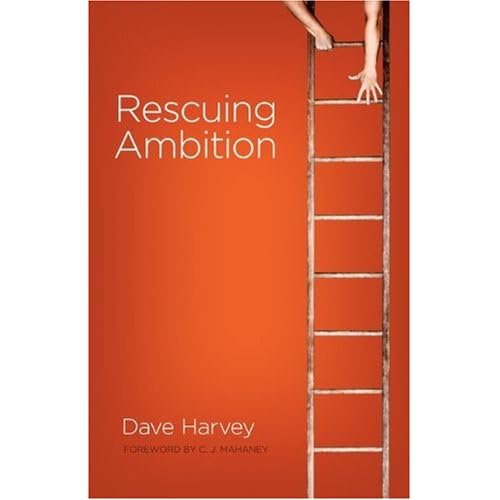
Rescuing Ambition

My friend Dave Harvey is coming out with another great book. Here is an intro from the Amazon site:

This pioneering book rescues ambition from suspicion by putting it to work for the glory of God.

Ambition has developed a reputation synonymous with the love of earthly honor and fame hunting. As a result, the organ of ambition—the God-implanted drive to improve, produce, develop, and create—is neglected and well on its way to paralysis. For some Christians, dreams are numbed. For others, there are no dreams; life just happens. One thing is certain: ambition needs help.

Dave Harvey is calling for a rescue. He wants to snatch ambition from the heap of failed motivations and put it to work for the glory of God. To understand our ambition, we must understand that we are on a quest for glory. Where we find glory determines the success of our quest. With his transparent humor and conversational tone, Harvey expounds on insights from Scripture and everyday life as he calls readers to reach further and dream bigger for the glory of God.

Go to Amazon here to pre-order.

Wednesday, December 02, 2009

The Purpose of "A Christmas Carol"

Just read a great article on the original context to Dickens' "A Christmas Carol". Bottom line, Charles Dickens wrote this classic and touching Christmas story not that we would wax nostalgic about old-fashioned Christmases but that our hearts would be stirred to give generously to the poor and thus "keep Christmas" well.

A question for us to consider: If Scrooge were alive today what sort of reforms would he make to keep Christmas well? How can we keep Christmas in terms of charity for needy folks?

Perhaps part of how we can celebrate Christmas this year is in giving to the needy. Here are someworthy causes to help us keep Christmas:
  1. Somebody Cares New England
  2. Five Talents
  3. Compassion International
  4. Hands & Feet Project
  5. Blood:Water Mission
Merry Christmas!

Wednesday, November 25, 2009

Need Some Good Advent Readings?

Are you looking for some good Advent devotionals? I came across this one from the Confederation of Reformed Evangelical Churches. It looks good. You can access it here.

HT: Nancy Wilson

Why Do You Go to Church?

Jeff Purswell has an excellent post on the biblical perspective on "going to church". Check out this excerpt:
"But you have come to Mount Zion and to the city of the living God, the heavenly Jerusalem, and to innumerable angels in festal gathering, and to the assembly of the firstborn who are enrolled in heaven, and to God, the judge of all, and to the spirits of the righteous made perfect, and to Jesus, the mediator of a new covenant, and to the sprinkled blood that speaks a better word than the blood of Abel." (Hebrews 12:22-24 ESV) ....

Sunday Morning


So back to your home church this upcoming Sunday. When you enter and the music begins, what are you more aware of? Is it the song set? the musicians? the mix? Does the worship band wow you? Does the routine bore you?

Or do you perceive something beyond all this?

Your church is one authentic manifestation of the entire people of God that right now is worshiping before the throne of God. That is the reality of new covenant worship. And when we begin to wrap our minds around that, there springs to mind a thousand reasons to rejoice, to praise, and to sing; and to renounce flippancy, self-display, selfishness, superficiality, sloppiness, and thoughtlessness.

Before the God who is a consuming fire, we don’t shuffle in casually. We don’t demand our artistic preferences. We don’t merely gather with our friends. We don’t merely sing together. As the people of God, we enter into the very presence of God. Encountering God in this way is the very nature of the church. By definition, to be the church is to gather in God’s presence and to worship God together. And when we begin singing, we join the glorious worship that takes place unceasingly before the throne of God.

This is true regardless of how we feel, who leads worship, what songs we sing, or how we think worship went. There is something incredible happening on Sunday morning!

Be the church and go to church. Something eternal is going on in there. Don’t miss it.

(Read more.....)

Sign the Manhattan Declaration

Are you concerned for our culture's misunderstanding of the right to life, the dignity of marriage and religious liberty? Then please consider signing the Manhattan Declaration.

This document winsomely, clearly and boldly presents a Christian worldview on these very important issues. The commitment elegantly communicated in this document is a vital one for every Christian dedicated to historic and biblical Christianity in a time of increasing confusion, controversy and conflict around Christian views of life, liberty and family.

Although some Christians might wrangle over the definition of "the gospel" in this document (see Tim Challis' post), I believe this is finding a tempest in a teacup. By signing the document you are in no way compromising either a Roman Catholic, Orthodox or Evangelical definition of the gospel. The document is constructed to allow Christians to unite over clear and historical Christian teaching on these social justice issues. Let's not lose an opportunity for forming a key and timely alliance because we would rather look for disagreement where none is intended.

I hope you are able to sign it!

Read the introduction below.

The Manhattan Declaration


Christians, when they have lived up to the highest ideals of their faith, have defended the weak and vulnerable and worked tirelessly to protect and strengthen vital institutions of civil society, beginning with the family.

We are Orthodox, Catholic, and evangelical Christians who have united at this hour to reaffirm fundamental truths about justice and the common good, and to call upon our fellow citizens, believers and non-believers alike, to join us in defending them. These truths are:
  1. the sanctity of human life
  2. the dignity of marriage as the conjugal union of husband and wife
  3. the rights of conscience and religious liberty.

Inasmuch as these truths are foundational to human dignity and the well-being of society, they are inviolable and non-negotiable. Because they are increasingly under assault from powerful forces in our culture, we are compelled today to speak out forcefully in their defense, and to commit ourselves to honoring them fully no matter what pressures are brought upon us and our institutions to abandon or compromise them. We make this commitment not as partisans of any political group but as followers of Jesus Christ, the crucified and risen Lord, who is the Way, the Truth, and the Life. (Read More Here, Download PDF Here)